Heat insulation

The Comfort Index heat score on every Estimia profile page is a quick translation of the technical Uw rating into a number you can compare at a glance. A 10 is a triple-glazed passive-house window; a 4 is a plain modern PVC unit. Everything below explains what the rating measures, what each step on the scale feels like in a real room, and which parts of the window construction actually decide where a given profile lands.

What the Uw value really tells you

Uw is the heat-loss coefficient of the whole window — frame, sash, glass and spacers added together. It is measured in watts per square metre per degree of temperature difference, so a smaller number means a warmer window. A worn aluminium unit from the 1990s sits around Uw 5.0; an entry-level modern PVC window lands at 1.3–1.5; a high-spec double-glazed unit with a low-E coating and argon reaches 1.0; and a triple-glazed passive-house window can dip below 0.7. The Comfort Index maps that range onto a 1–10 scale so two completely different profiles can be lined up without a calculator.

Less heating energy lost to the street
No cold pane, no condensation strip on a winter morning
An even room temperature edge to edge, no "cold zone" by the window
Uw 1.0
The sweet spot for
most Spanish homes

How the score is calculated

The Comfort Index reads the Uw figure straight off the manufacturer's data sheet and maps the typical residential range onto a familiar 1–10 scale. Roughly: Uw 0.7 maps to 10, Uw 1.0 to about 8, Uw 1.3 to 6 and Uw 1.5 to 4. When a profile does not publish a Uw — most often older aluminium systems — the index falls back to its energy-efficiency class. The exact numbers matter less than the comparison: two windows with scores three points apart will feel noticeably different in winter; two windows one point apart will not.

What 9/10 feels like versus 5/10

On a cold January morning, a 5/10 window in a typical Spanish flat will sit at around 12–14 °C on the inner pane while the room is at 20 °C. Stand near it and you feel a soft chill — the "phantom draft" of cool air sliding off the glass. A 9/10 window keeps the inner pane closer to 18 °C; the chill is gone, condensation rarely forms, and the heating thermostat clicks off sooner because the room loses less warmth overnight. Over a heating season the difference can be 20–30% of the bill, depending on how exposed the wall is.

What pushes a window up the scale

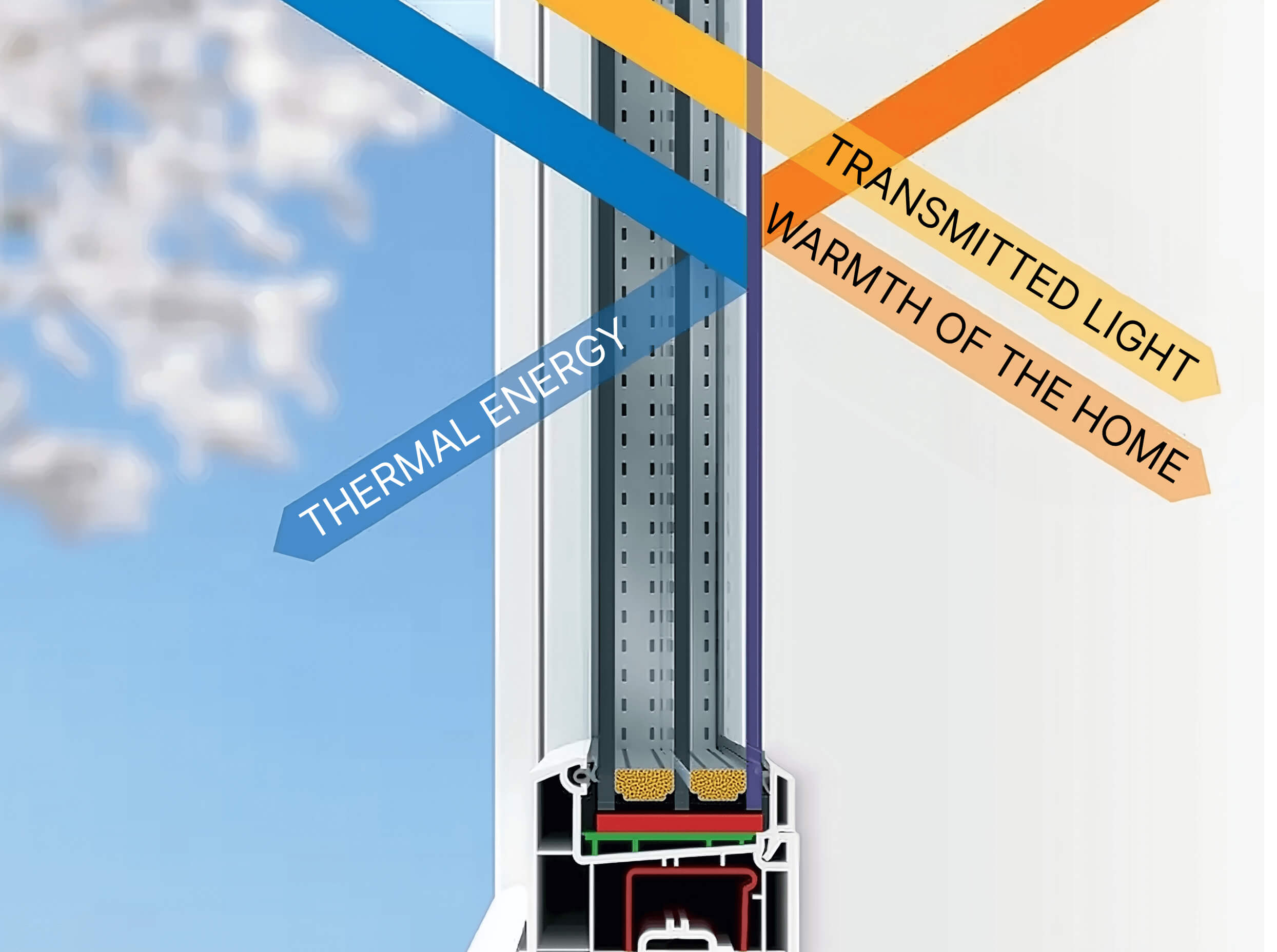
Four parts of the construction do most of the work. First, the glass package: a low-E coating on one of the inner surfaces reflects indoor heat back into the room, and argon in the chamber slows conduction across the gap. Second, the spacer bar around the perimeter of the glass — a plastic-composite warm-edge version is worth roughly one decimal place of Uw versus old aluminium. Third, the profile itself: a 70 mm five-chamber PVC frame is the modern baseline; an 80–90 mm seven-chamber frame with a foam insert is the upgrade. Fourth, the install: a properly foamed perimeter and a sealed reveal can rescue a great window from a careless installation, or sabotage a great one.

How much insulation is enough?

For most of mainland Spain, a Comfort Index heat score of 7 or 8 (Uw around 1.0–1.2) is the right target — comfortable, no condensation, sensible payback on the upgrade. In Galicia, the meseta and any cold-winter mountain region, aim for 8 or above. For passive-house projects, north-facing rooms or any building chasing a top energy certificate, 9 or 10 (triple glazing) starts to earn back its higher cost. On the warm Mediterranean coast, going past 8 is rarely worth the extra euros — the savings shrink with the mild winters.

What the score does not capture

The Comfort Index focuses on steady-state heat loss, which is what most households actually pay for. It does not, on its own, tell you about solar gain (the heat that comes in through the glass on a sunny day), about the g-value used for summer comfort, or about overheating risk on west-facing facades. For a south-facing balcony in Andalusia, a multifunctional glass unit (solar control plus low-E) often beats a pure heat-insulating one on year-round comfort even though its raw Uw is slightly higher.
FAQs

Frequently asked questions

Is a higher Comfort Index heat score always better?

For winter warmth, yes — a higher score means less heat lost. But pushing past 8 in a mild climate pays back slowly, and triple glazing is heavier, darker and pricier. Match the score to the climate and the orientation of the room, not the marketing brochure.

Where can I find the Uw value on a quote?

It is on the technical data sheet of the window, usually as "Uw" or "transmitancia térmica". If a quote does not state it explicitly, ask. Reputable installers list it on every offer — a refusal to share it is a red flag.

Does the frame material change the score?

Yes. PVC and modern thermally broken aluminium can both reach Uw 1.0 or better. Old aluminium without a thermal break almost never does. Wood-aluminium composites land in the middle. The Comfort Index reads the published Uw of the whole unit, so the frame material is already baked in.

Will a 9/10 window stop a cold draft I feel near the wall?

It will stop the "phantom draft" — the cool air that slides off a chilly pane. A real draft (air actually moving through a gap) is a sealing problem, usually around the frame perimeter or a worn gasket. Higher heat insulation will not fix that on its own.

How does heat insulation interact with EU subsidies?

Most Spanish renovation aids set a maximum Uw that the new windows must beat (often 1.4 or 1.2). A Comfort Index score of 6 or above usually clears the bar; anything 7 or higher comfortably qualifies. Always check the specific call for the exact threshold.

Can the score change if I add an inner shutter or curtain?

The published Uw is the window alone. A heavy interior curtain or a closed roller shutter outside adds a still-air layer that improves real-world insulation by 10–20%, but it does not change the rating on the spec sheet. Useful in practice, ignored in the index.

Ready to spec your windows?

Use the 3D configurator to size up your windows and see a fair market price. Or compare the leading PVC and aluminium brands side by side.