How the score is calculated
The Comfort Index reads the Rw figure straight off the manufacturer's data sheet and maps the typical residential range onto a 1–10 scale. Roughly: Rw 35 dB maps to 1, Rw 38 dB to about 3, Rw 42 dB to 6, Rw 45 dB to 8 and Rw 50 dB to 10. The exact number matters less than the comparison: two windows three points apart on the index will feel meaningfully different at 3 a.m.; two windows one point apart probably will not.
What 8/10 sounds like versus 5/10
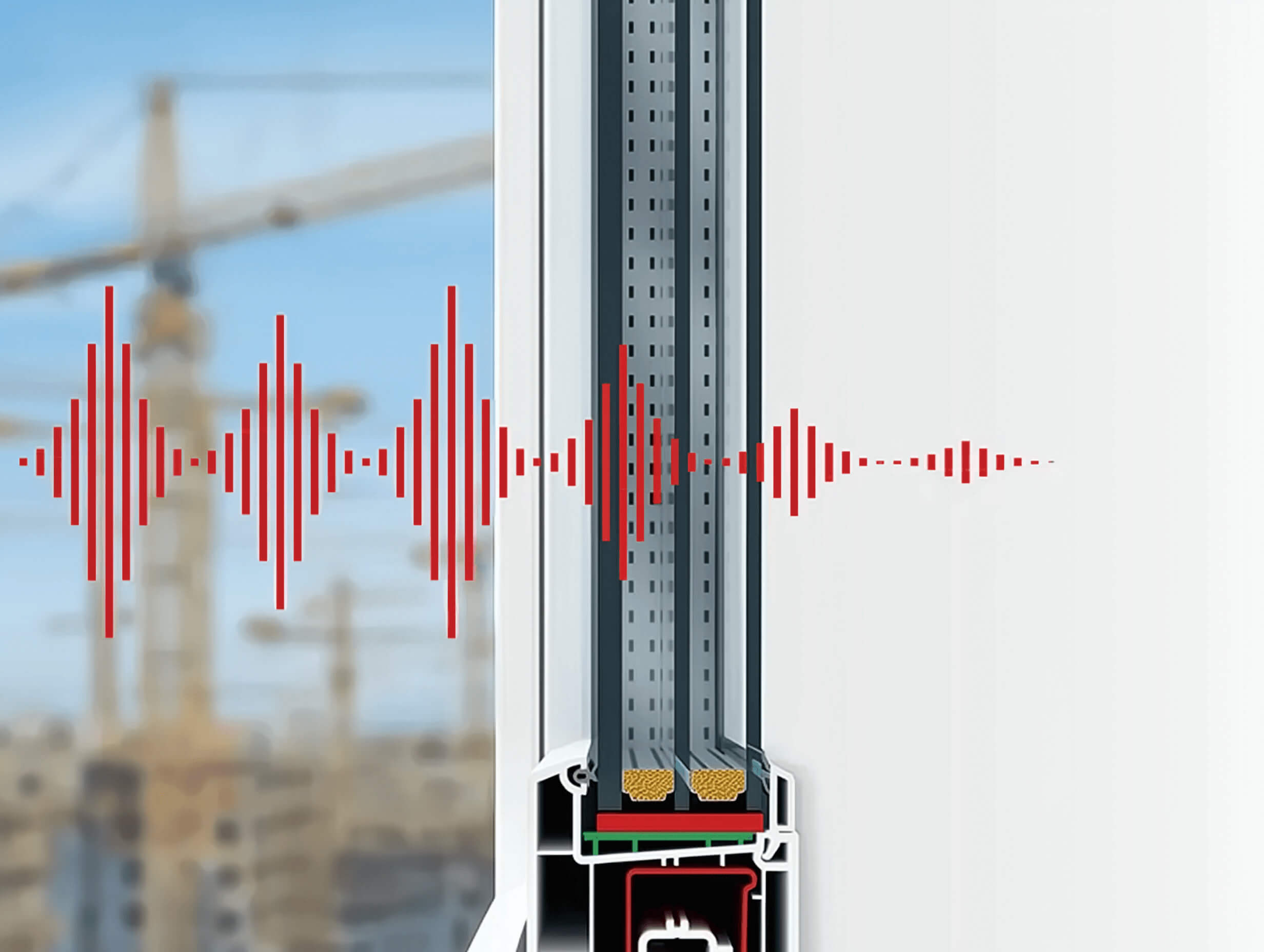
Stand by a kerb on a busy two-way street and the sound level is around 75 dB. A 5/10 window (Rw ≈ 38 dB) drops that to about 37 dB inside the room — the level of a quiet office; you still hear every truck and every loud conversation. An 8/10 window (Rw ≈ 45 dB) drops it to around 30 dB — the level of a quiet library; the same trucks become a low whoosh, voices become unintelligible mumbles. For light sleepers, the difference between 5/10 and 8/10 is often the difference between earplugs and no earplugs.
What pushes a window up the scale
Three parts of the construction do most of the work. First, asymmetric panes — for example 4 mm outside and 6 mm inside. Two identical panes share a band of frequencies where they both vibrate freely and let sound through; mixing thicknesses spreads those weak spots and is worth three to four decibels with no extra cost. Second, a wider chamber on the street side, ideally filled with argon: low-frequency rumble (trucks, buses, AC compressors) hates a deeper cushion. Third — and the single biggest acoustic upgrade — a laminated pane on the inside or outside, where a soft plastic film between two thinner panes swallows vibration before it can travel into the room.
How much insulation is enough?
For a quiet residential street or a courtyard-facing flat, a Comfort Index noise score of 5 or 6 (Rw 38–42 dB) is the sensible default. For a busy avenue, a school nearby or a city centre with active nightlife, aim for 7 or 8 (Rw 43–46 dB). For windows that face a tram line, a metro vent, a train track or a motorway, target 9 or 10 (Rw 47–50 dB) and insist on a laminated outer pane. Pushing further than 10 buys diminishing returns — at that point most of the remaining noise sneaks in around the frame, not through the glass.
The rest of the wall still matters
Sound finds any gap. A 9/10 window in a sloppy install will still leak noise around the perimeter — full-perimeter foam, sealed reveals and a properly compressed gasket are non-negotiable. Trickle vents in the frame are tiny acoustic holes; if you need fresh air without opening the window, ask for an acoustic-rated vent (around 35 dB Dn,e,w). A plain vent can undo most of the work the glass does.
What the score does not capture
The Comfort Index reads steady-state airborne noise — traffic, voices, street music. It does not measure structural noise (footsteps from the flat upstairs, plumbing in the wall), which needs decoupled floors and pipe wraps, not windows. It also smooths over the difference between Rw and the spectrum adaptation terms C and Ctr that appear on detailed acoustic specs. For most residential decisions the single index number is enough; for a project beside a flight path or a rail line, ask for the full Rw (C; Ctr) triplet.