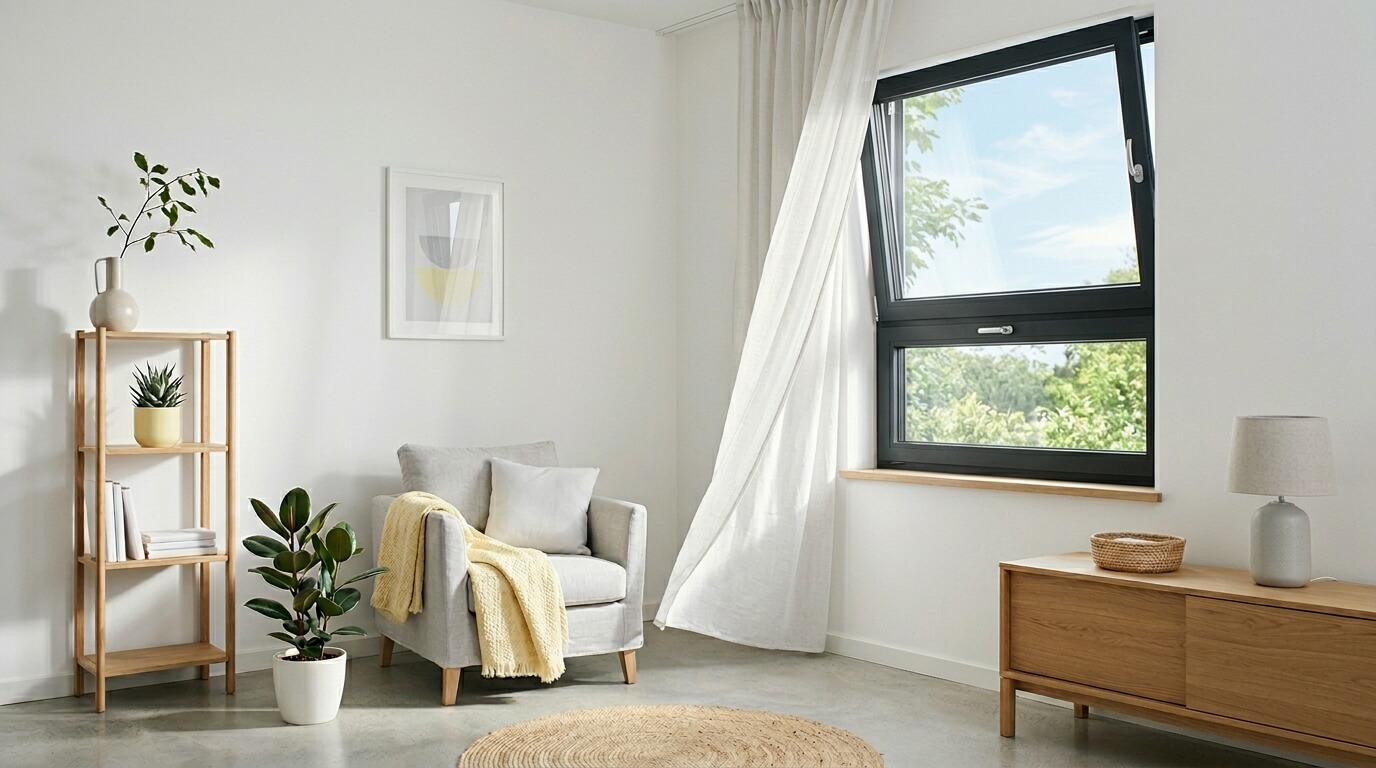
Walk into almost any newly renovated flat in Madrid, Valencia or Bilbao and you will find the same window: a frame that tilts inward at the top for a draught-free airing, then swings wide open like a door when you turn the handle the other way. In Spanish it is the ventana oscilobatiente — the tilt-and-turn window — and it has quietly become the default choice for serious window replacements across the country. It is not a fashion. It is the combination that seals best, insulates best and ventilates most safely, all from a single handle.
If you are comparing quotes for new windows, understanding the oscilobatiente is the fastest way to judge whether a company actually knows its product. This guide explains exactly how the dual opening works, where it beats sliding and casement designs, where it does not, and what a fair price looks like in Spain right now.
What “oscilobatiente” actually means
The word combines two movements:
- Oscilo (oscillation / tilt): the window tips inward from the bottom hinge, with the top edge leaning in a few centimetres. This is the ventilation position.
- Batiente (turn / swing): the same sash swings fully inward on side hinges, like a casement window opening into the room.
One handle controls both. The handle position tells the hardware what to do:
| Handle position | What the window does |
|---|---|
| Down | Fully closed and locked |
| Horizontal (90°) | Turn — swings fully open inward |
| Up (180°) | Tilt — leans inward at the top for ventilation |
That single-handle logic is the whole appeal. You are never juggling separate latches, and the window cannot be in two states at once.
The mechanism and hardware
The magic is not in the frame — it is in the perimeter hardware (the herrajes), the hidden steel mechanism running around the entire sash. Brands you will see quoted in Spain include Roto, Maco, GU and Siegenia. When you compare quotes, the hardware brand matters as much as the profile brand, because it is what makes the window seal, lock and last.
How it works:
- Turning the handle drives a continuous gear strip around the sash.
- That strip moves a row of locking cams that pull the sash tight against the frame at multiple points (typically 4–8).
- Depending on the handle position, the hardware either engages the bottom pivot (tilt) or the side hinges (turn).
- A built-in mis-handling device stops you switching modes while the window is mid-swing.
Because the sash is clamped at many points around its whole edge, the rubber gaskets compress evenly. That even compression is the root cause of nearly every advantage below.
Why it seals, insulates and silences so well
A tilt-and-turn closes by pressing the sash flat into the frame against two or three lines of gasket. Compare that with a slider, where two panels simply pass each other and rely on brushes — there is always a path for air along the rails. The result:
- Air-tightness. Oscilobatiente windows routinely reach the top air-permeability class. For draughty older Spanish flats, this is the single biggest comfort upgrade.
- Insulation (Uw). With a good profile and double or triple glazing, whole-window Uw values of roughly 1.0–1.6 W/m²K are normal. (For more on reading that number, see our guide on the Uw value.)
- Acoustics. The same tight seal that blocks air blocks sound. With laminated acoustic glass, 30–42 dB of reduction is achievable — a serious difference on a busy avenida.
- Security. Those multiple locking cams engage steel keepers around the frame. Add anti-burglary keepers (RC2) and a lockable handle and you have a window that resists levering far better than a single-point latch.
Micro-ventilation: the underrated feature
Most quality hardware offers an intermediate micro-ventilation setting — a slight tilt of just a few millimetres that lets stale air escape without opening the window to wind, rain or noise. In the Spanish climate this is genuinely useful: you can air a bedroom overnight in summer along the Mediterranean coast without inviting mosquitoes through a wide-open sash, and in winter you avoid the condensation that builds up in sealed, well-insulated homes. It is also the safest “always-on” ventilation position for homes with children.
Pros and cons versus other window types
Versus sliding windows (correderas)
| Tilt-and-turn | Sliding | |
|---|---|---|
| Seal & insulation | Excellent | Moderate (rail gaps) |
| Floor space used | Sash swings into room | Zero — slides along rail |
| Cleaning | Easy (swings fully in) | Outer pane can be awkward |
| Best for | Bedrooms, kitchens, living rooms | Balconies, terraces, tight rooms |
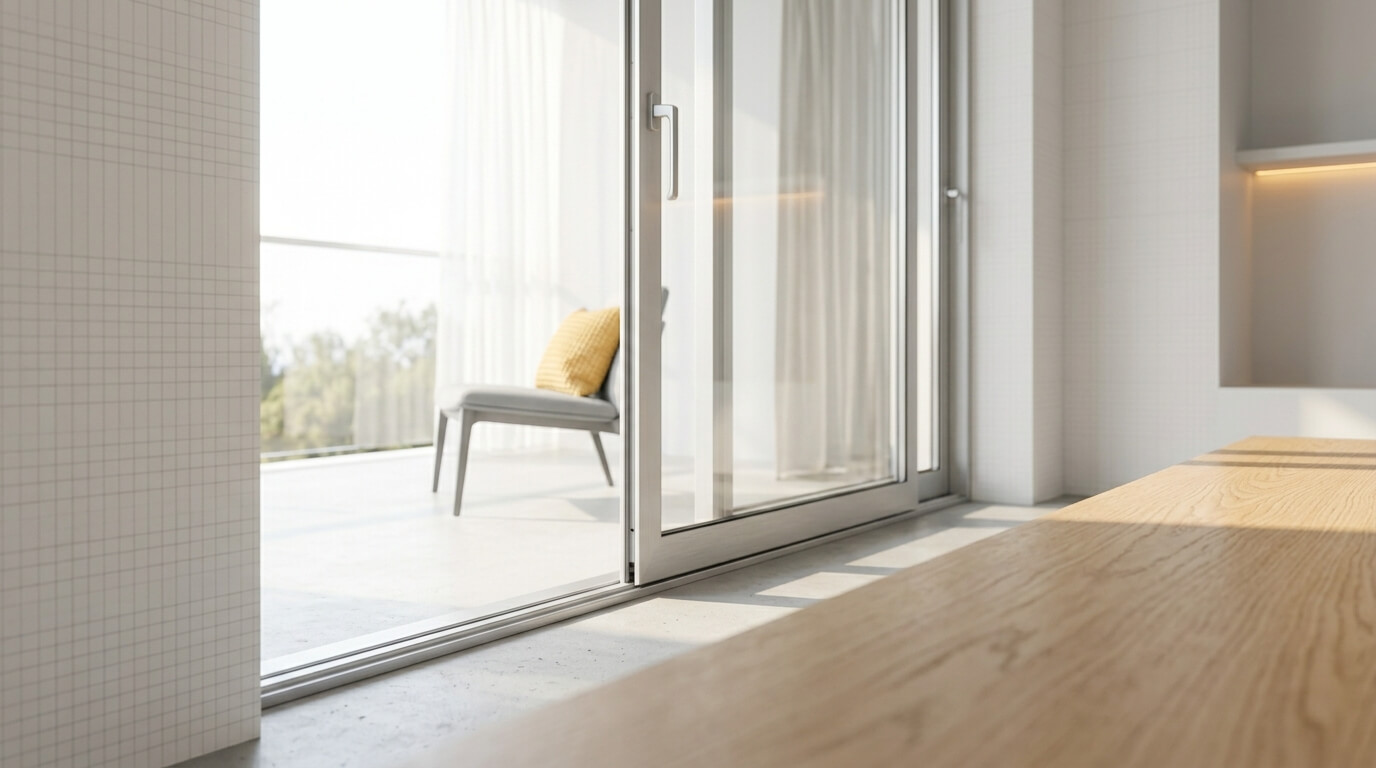
The slider’s one big advantage is that nothing intrudes into the room — which is exactly why terraces and balconies often use sliding doors instead. If you are weighing up a terrace opening, our guide on how to choose a sliding door covers that decision in detail.
Versus casement windows (practicables / abatibles)
A plain casement only swings open — no tilt. The oscilobatiente gives you everything a casement does plus the tilt position, for a modest extra cost. There is rarely a good reason to choose a simple inward casement over a tilt-and-turn today; the hardware difference is small and the gain in everyday usability is large.
The honest drawbacks
- It opens inward, so it competes with curtains, blinds fitted inside the reveal, and anything on the windowsill.
- The swing needs clear space — not ideal directly over a kitchen sink or behind a sofa.
- The hardware is more complex than a fixed or sliding window, so quality and correct adjustment matter more.
Which rooms suit it best
- Bedrooms — tilt for safe overnight airing, full turn for cleaning.
- Kitchens — micro-ventilation clears cooking humidity without a draught (mind the swing over worktops).
- Living rooms — the best seal and acoustics where you spend most time.
- Bathrooms — tilt position vents moisture safely and discreetly.
For large terrace and balcony openings where an inward swing is impractical, pair the oscilobatiente in your rooms with a sliding or lift-and-slide door for the terrace — and for full-height glass walls, look at panoramic windows and patio doors.
Price considerations in Spain (2026)
Prices vary by material, glazing and size, but as a realistic guide for a supplied-and-fitted oscilobatiente:
| Material | Typical price (supplied & fitted) |
|---|---|
| PVC | €280–€500 / m² |
| Aluminium (with thermal break) | €350–€650 / m² |
| Wood / wood-aluminium | €500–€900+ / m² |
What moves the price:
- Glazing. Triple glazing and laminated acoustic or solar-control glass add cost but are worth it in noisy cities and hot southern zones.
- Hardware spec. RC2 security keepers and premium brands (Roto, Siegenia) add a little but pay off in durability.
- Size and quantity. Larger sashes need stronger hardware; whole-home replacements lower the per-window price.
A few cost levers worth knowing in 2026:
- IRPF deductions for energy-efficiency improvements remain available for qualifying renovations — keep the energy certificate and invoices.
- NextGenerationEU rehabilitation grants are winding down, with the main programmes due to close by December 2026, so anyone planning a deep retrofit should not leave it late.
- In a comunidad de vecinos, changing window colour or external appearance on a façade usually needs community approval — confirm before ordering.
How to compare quotes the smart way
A cheap oscilobatiente with weak hardware and a thin profile will under-perform a well-specified slider. The specification — profile chambers, glazing, hardware brand, security class and the whole-window Uw — matters more than the headline price. The trouble is that quotes are hard to compare when each installer lists things differently.
That is exactly what Estimia is for. Every window company listed on Estimia is verified and quality-controlled before it can receive enquiries, and you can request and compare several quotes side by side instead of chasing installers one at a time. You get a clear view of price, specification and warranty from proven local contractors — and the leverage that comes from real comparison.
The bottom line
The oscilobatiente earned its dominance honestly: one handle, two openings, the best seal in the business, safe micro-ventilation and effortless cleaning. For nearly every room of a Spanish home it is the sensible default. Reserve sliders and panoramic systems for the terrace and the big views — and use tilt-and-turn everywhere comfort, quiet and insulation matter most.
Compare verified window companies on Estimia and get several quotes to compare side by side — so you choose on real specification, not just price.