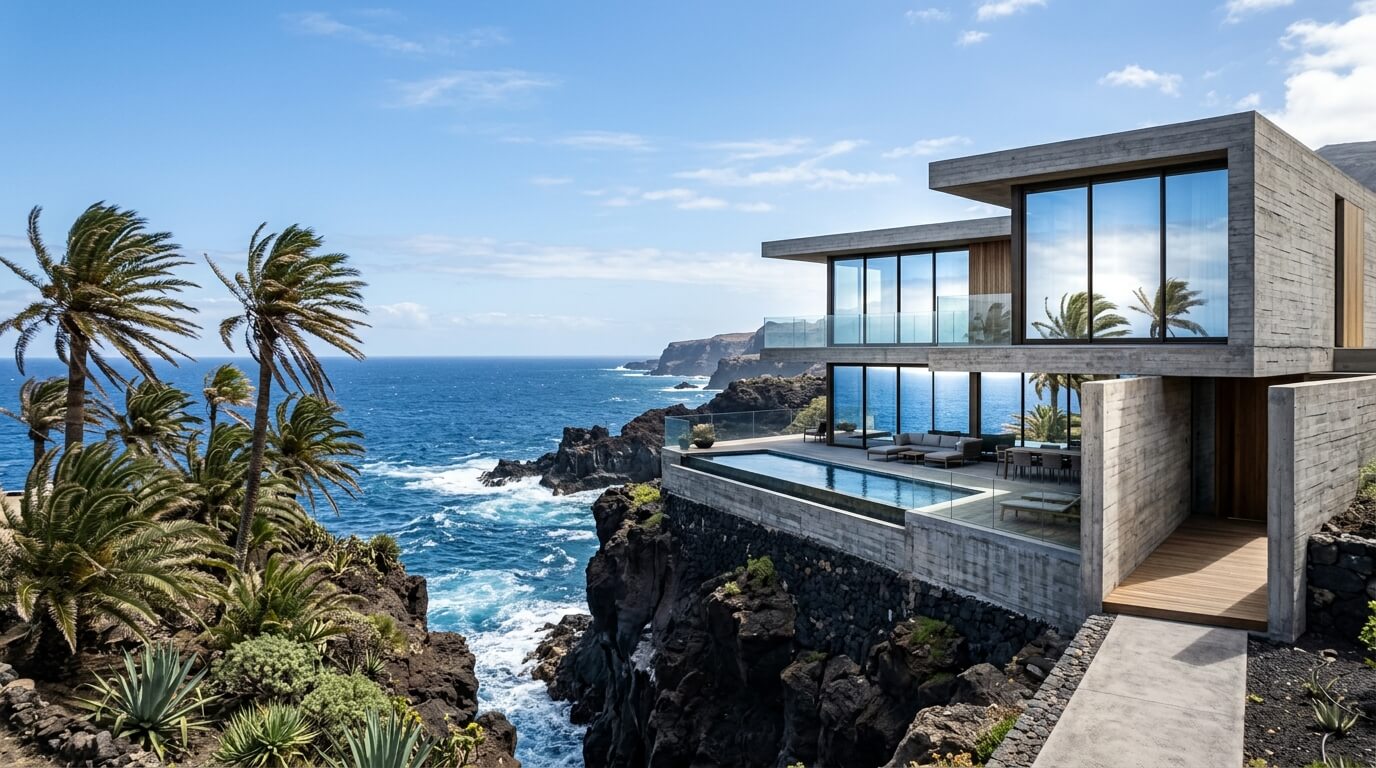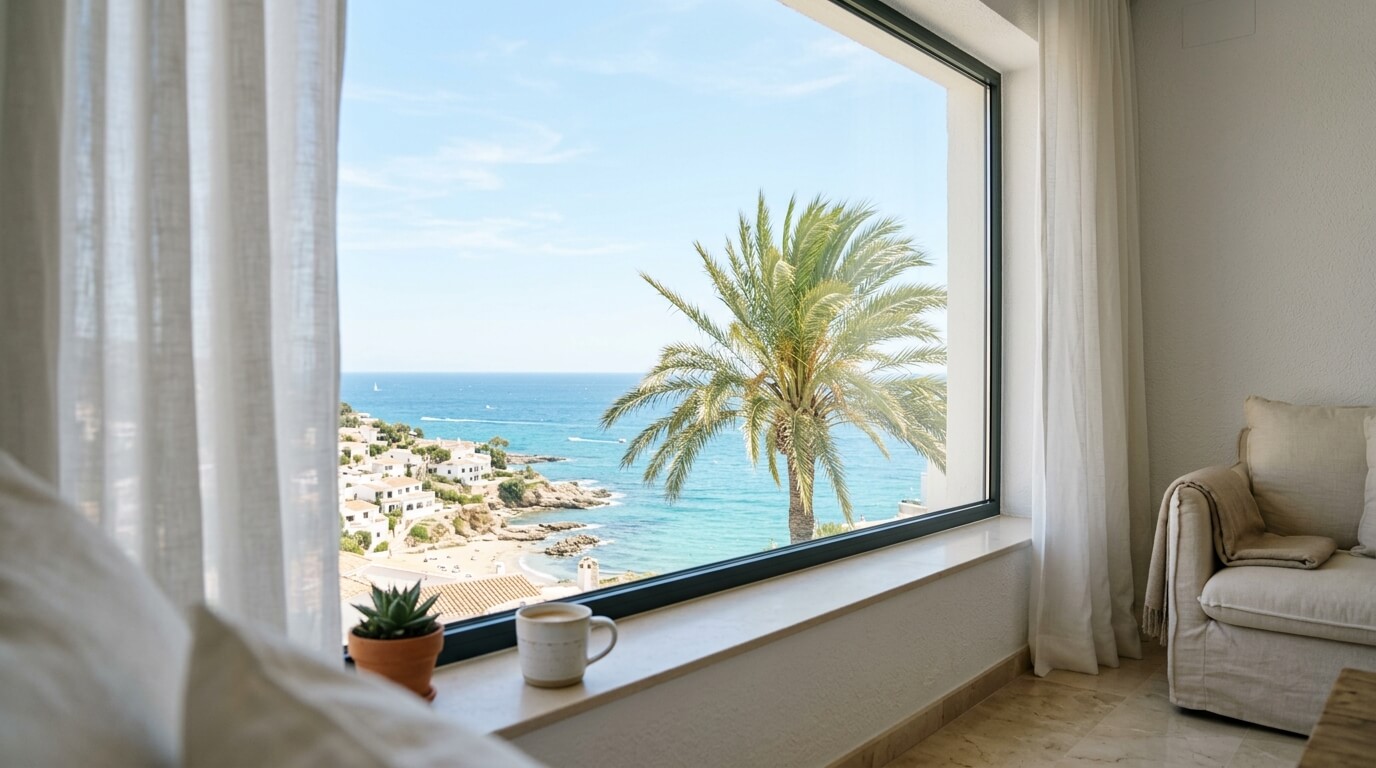
If you live anywhere along Spain’s Mediterranean arc — from the Costa Brava down through Valencia, the Costa Blanca, the Costa del Sol and across to the Balearics — the window that performs brilliantly in Madrid or León is often the wrong window for you. The enemy here is not the bitter winter that drives window choice in the north and the meseta. It is intense, near-year-round sun, salt-laden sea air and high summer humidity. Get the specification right and your windows keep the house cool, stay corrosion-free for decades and barely move your air-conditioning bill. Get it wrong and you end up with an oven behind glass, seized hardware and chalky, sun-bleached frames within a few seasons.
This guide is the Mediterranean-coast reference for 2026. We focus on the priorities that genuinely matter by the sea — solar control, UV stability, corrosion-resistant hardware, sliding systems for terraces, and the PVC-versus-aluminium question in a salt environment — and finish with region-specific notes for the main costas. Because the right answer changes from a sheltered inland urbanización to a first-line beachfront flat, Estimia lets you request and compare quotes from verified window companies that already work in your stretch of coast, rather than gambling on whoever advertises loudest.
The coastal problem in one sentence
In most of Spain the goal of a good window is to keep heat in. On the Mediterranean coast the dominant goal for most of the year is to keep heat out while resisting salt corrosion and UV degradation. Almost every recommendation below follows from that single inversion.
Solar control: the g-value is the number that matters
Inland, homeowners obsess over the Uw value (how well a window insulates against heat loss — lower is better). On the coast it matters too, but the figure that decides whether your living room is liveable in August is the g-value, also called the solar factor. It expresses the fraction of the sun’s heat that passes through the glass:
- g ≈ 0.6–0.7 — standard clear double glazing. Lets in most of the solar heat. Fine in the north, a mistake on a south- or west-facing coastal façade.
- g ≈ 0.35–0.45 — solar-control glazing. Blocks roughly half to two-thirds of the incoming solar heat while keeping the room bright.
- g ≈ 0.25–0.35 — high-performance solar-control / selective coatings for very exposed, west-facing or sea-front glass.
A west-facing terrace on the Costa del Sol with clear glass can turn a room into a greenhouse by mid-afternoon. The same opening with a solar-control coating (control solar) can cut the heat gain dramatically, which translates straight into a smaller air-conditioning load. As a rule of thumb on the coast: prioritise a low g-value on every south- and west-facing opening, and accept a slightly higher one only on shaded or north-facing glass where you want the winter warmth.
Glazing is not the only lever. External shading wins every time it can be used — persianas, exterior blinds, toldos, brise-soleil and deep reveals stop the sun before it ever reaches the glass, and a solar-control unit behind good external shading is the gold standard.
UV stability: why coastal sun destroys cheap frames
The Mediterranean delivers some of the highest annual sunlight hours in Europe. Ultraviolet radiation slowly attacks plastics and pigments, so profile UV stability is not optional here:
- White PVC handles UV very well and is the default value choice.
- Dark or coloured PVC absorbs far more heat and can warp or fade if it is not a quality, UV-stabilised, foiled profile rated for southern climates. On a blazing south façade, a cheap dark PVC frame is a genuine risk — insist on a profile the manufacturer explicitly warrants for high-insolation regions.
- Powder-coated aluminium is extremely UV-stable; its colour holds for decades, which is one reason aluminium is so common on the coast.
The practical takeaway: if you want dark frames in full sun — and many coastal homeowners do, aesthetically — aluminium is the safer bet than dark PVC, or you pay for a premium, properly warranted PVC foil.
Salt air and corrosion-resistant hardware
Within a few hundred metres of the sea, everything metal is under attack. Airborne salt accelerates corrosion, and the first casualty is rarely the frame — it is the hardware: hinges, locking points, handles, the rollers inside sliding doors. Seized or rusted mechanisms are the single most common coastal failure.
What to specify near the sea:
- Marine-grade / corrosion-resistant hardware. Reputable systems offer hardware with enhanced anti-corrosion coatings (often tested to high salt-spray standards). On first-line property this should be a stated requirement, not an upsell you discover later.
- Stainless-steel fixings rather than ordinary steel.
- For aluminium, ask about the coating quality — a Qualicoat Seaside / Qualimarine class powder coat is specifically designed for marine environments and resists salt far better than a standard finish.
- Rinseable, accessible tracks on sliding systems, because salt and dust collect there.
Maintenance also changes by the sea: an occasional fresh-water rinse of frames, tracks and hardware genuinely extends their life. It is worth asking any installer what corrosion warranty they offer for sea-front work.
Sliding systems for terraces
Coastal living is terrace living, and the large openings onto terraces, porches and pool areas are usually the defining feature of a Mediterranean home. The options:
- Lift-and-slide (elevadora) doors — the premium choice for big spans. They lift off their seals to glide, then drop down to seal tightly, giving good watertightness and air-tightness across very wide openings. Ideal where you want a near-frameless wall of glass onto a sea view.
- Standard sliding (corredera) and tilt-slide — more economical, fine for smaller terrace openings, but generally less airtight than a lift-and-slide.
- Minimal-frame / slim sliding systems — maximise glass and view, popular on first-line property, at a premium price.
For large terrace spans, thermal-break aluminium dominates because it carries big panes on slim sightlines that PVC struggles to match. The trade-off is that the glazing on those huge panes does a lot of work — pair big sliding spans with solar-control glass or the terrace room becomes the hottest in the house.
PVC vs aluminium on a salty, sunny coast
This is the question every coastal homeowner asks. There is no universal winner — it depends on the opening and the exposure.
| Factor | PVC | Aluminium (thermal break) |
|---|---|---|
| Thermal insulation | Better insulator for the price | Good only with a proper thermal break |
| Salt corrosion | Frame is immune (it’s plastic); only hardware is at risk | Frame resists well with a marine-grade (Qualimarine) coat |
| UV / dark colours in full sun | Risky in dark unless premium foil | Excellent — holds colour for decades |
| Large terrace sliders | Limited span; bulkier frames | Excels — slim sightlines, big spans |
| Typical installed €/m² | ~€280–€480 | ~€350–€650 |
A sensible coastal home often mixes both: PVC for the bedroom and bathroom windows where insulation and value matter, and thermal-break aluminium for the large terrace sliders where span, slim profiles and UV-stable dark finishes matter. There is nothing wrong with specifying two materials in one quote — and it is one of the things worth making explicit when you compare offers, since some installers only fit one or the other.
Region-by-region notes
Costa Blanca (Alicante, Torrevieja, Benidorm, Jávea). Extremely high sunlight hours and a large expat market. Solar control and UV-stable frames are the headline priorities; salt matters most on first-line property. White PVC for general openings, thermal-break aluminium for the big terrace sliders is a very common, well-judged combination here.
Costa del Sol (Málaga, Marbella, Estepona). Hot, sunny and increasingly humid in summer. West-facing sea views are gorgeous but brutal for solar gain — low g-value glazing plus external shading is essential. Premium aluminium with marine-grade coating is popular on the luxury first line.
Costa Brava and Costa Dorada (Girona, Tarragona). Slightly milder, but salt exposure on exposed headlands is real. Mediterranean sun still warrants solar control on south/west glass; a balanced PVC-plus-aluminium spec works well.
Valencia and the Costa de Azahar. Hot, humid summers; humidity control and good ventilation (tilt-and-turn, or oscilobatiente, for secure night airing) matter alongside solar control.
Balearic Islands (Mallorca, Menorca, Ibiza). Intense sun and a genuinely marine environment across most of the property stock. Corrosion-resistant hardware and quality coatings are close to mandatory; salt-tolerant specifications should be the default, not the exception.
A note on the Canary Islands: although Spanish, they sit in a subtropical Atlantic climate with their own (often very mild, very sunny, very salty) profile — the solar-control and corrosion logic above applies, but the heating need is even lower.
What to specify on the coast — a checklist
- Solar-control glazing (low g-value) on every south- and west-facing opening.
- UV-stabilised frames: white PVC, or aluminium / premium foiled PVC for dark colours in full sun.
- Corrosion-resistant, marine-grade hardware and stainless fixings near the sea.
- Qualimarine / Qualicoat Seaside powder coat on aluminium within a few hundred metres of the water.
- Lift-and-slide systems for large terrace spans, with solar-control glass.
- External shading wherever the architecture allows.
If your home is first-line and very exposed to wind off the sea, watertightness and wind-load ratings become critical too — see our companion guide on wind loads in coastal areas for the EN 12210/12208/12207 classes you should be asking for.
Conclusion
On the Mediterranean coast, the brief flips: you are designing windows to keep heat out, resist salt and survive intense sun, not to fight the cold. That means leading with the g-value, insisting on UV-stable profiles and corrosion-resistant hardware, choosing aluminium for big terrace sliders and dark finishes while PVC handles the rest, and never forgetting external shading. The right balance shifts from the Costa Brava to Ibiza, and from a sheltered villa to a sea-front flat.
Compare verified coastal-window companies on Estimia and get several like-for-like quotes side by side — every company is vetted before it can receive your enquiry, so you are comparing installers who genuinely understand sun, salt and sliding terraces, not just the lowest number on the page.