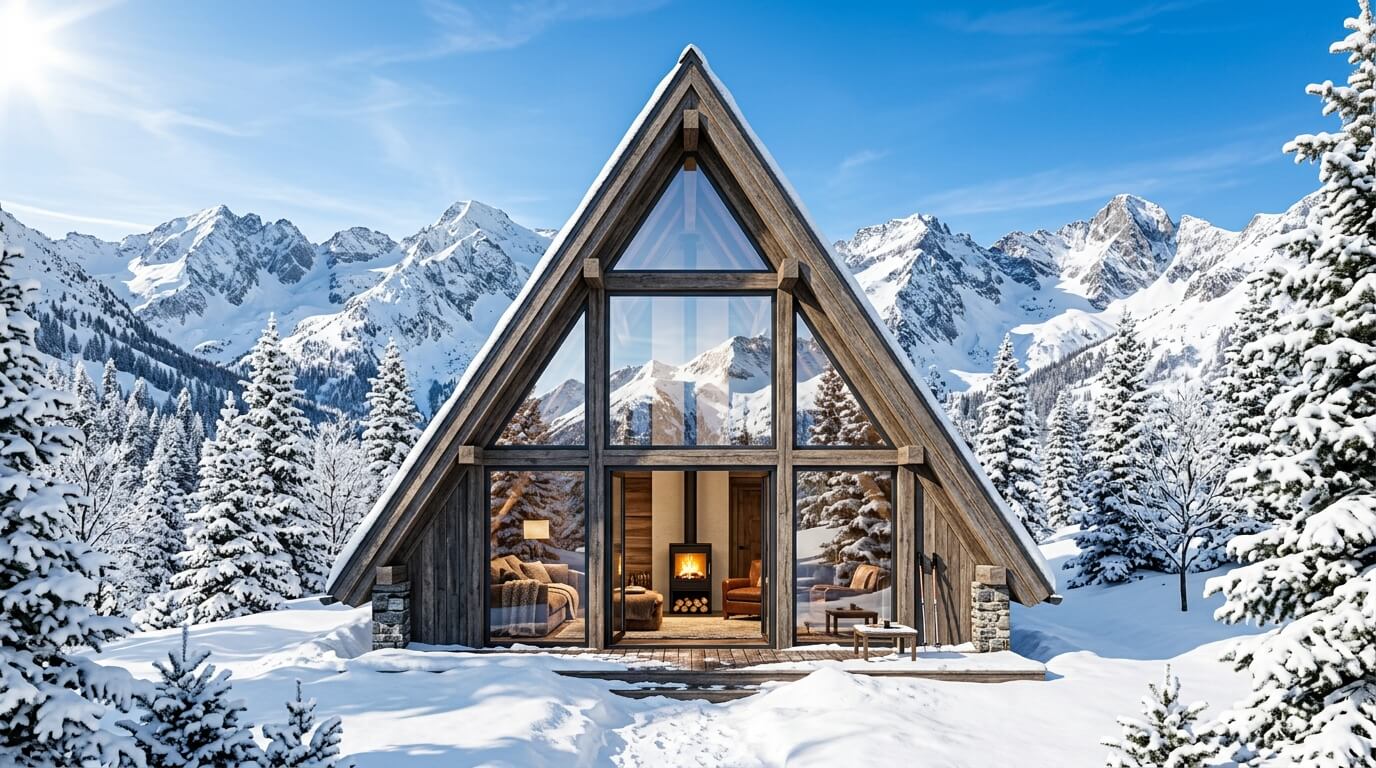
If your home is in the mountains — the Pyrenees, the Sierra Nevada, the high sierras of the interior, or the upland villages of Castilla y León and Aragón — the windows that suit the Mediterranean coast are exactly wrong for you. Here the climate is at its most severe in Spain: long, hard winters with deep frost and snow, intense ultraviolet at altitude, and large swings between cold nights and bright days. Windows are the weakest point in the thermal envelope, and at altitude that weakness is punishing. This guide is the mountain-home reference.
Because exposure at altitude varies sharply — a sheltered valley village versus a wind-exposed ridge chalet — Estimia lets you request and compare quotes from verified window companies that work in your area, so you compare installers who genuinely understand mountain conditions rather than coastal ones.
The mountain problem in one sentence
On the coast a good window keeps heat out; in the mountains its overriding job is to keep heat in through a long, cold winter while resisting frost, condensation and the structural loads of wind and snow. Almost every recommendation below follows from that.
Insulation is everything: aim well below the legal minimum
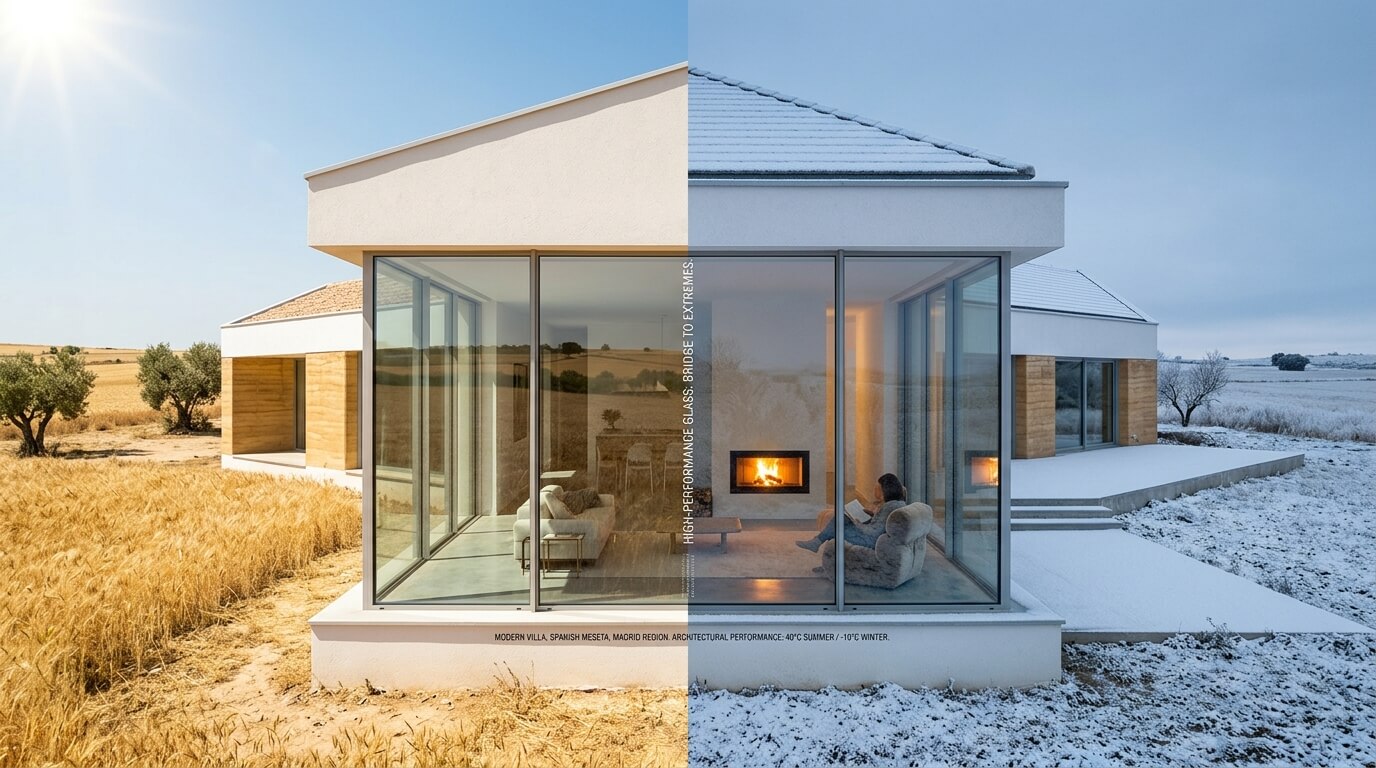
Mountain Spain sits in CTE winter climate zones D and E — the most demanding in the country. The building code caps window Uw at 1.8 W/m²·K here, but in a genuine mountain climate you should aim well below that for comfort and a manageable heating bill:
- Double glazing (argon + low-e): Uw ≈ 1.1–1.4 W/m²·K — the sensible baseline.
- Triple glazing: Uw ≈ 0.7–1.0 W/m²·K — this is one of the few places in Spain where the third pane genuinely pays back, because the heating season is long and cold. See How to Choose Triple-Glazed Windows.
The lower the Uw, the warmer the inner glass surface — which means more comfort (no cold radiant wall of glass) and far less condensation. Our guides What Is the Uw Value of a Window and Energy-Efficient Windows in Winter cover the numbers in full.
Frames: insulate, and beware the cold bridge
The frame must match the glass, or it becomes the weak link:
- High-chamber PVC (70–82 mm, 5–7 chambers) is an excellent insulator for the money and a popular mountain choice.
- Thermal-break aluminium is essential if you choose aluminium — without a generous polyamide thermal break, the frame becomes a cold bridge that streams with condensation and ices internally in hard frost. At altitude, specify a wide thermal break.
- Warm-edge spacers at the glass perimeter cut heat loss and condensation exactly where the cold gets in.
See PVC or Aluminium Windows for the material trade-offs.
Airtightness against mountain wind
Cold is one thing; cold wind driving through gaps is another. Mountain and ridge sites see strong gusts, so airtightness is as important as the glass:
- Air permeability Class 4 (EN 12207) — the best class, so wind doesn’t drive draughts through the seals.
- Wind resistance (EN 12210) — the structural class, important on exposed ridges and chalets.
- Watertightness (EN 12208) — wind-driven rain and melting snow.
Our guide Wind Loads in Coastal Areas explains these EN classes; the same standards apply to exposed mountain sites.
Condensation and ventilation in the cold
Efficient mountain windows have warm inner surfaces, so room moisture no longer condenses on the glass — but they are also very airtight, so ventilation must be deliberate. In a tightly sealed mountain home, trapped humidity will find the next-coldest surface (a reveal, a corner) if you don’t manage it. Specify trickle vents or a humidity-controlled ventilation strategy, and use tilt-and-turn (oscilobatiente) windows for controlled, secure airing. See Condensation on Windows and Tilt-and-Turn Windows.
High-altitude UV and solar gain
Two altitude-specific points homeowners miss:
- UV is stronger at altitude. It degrades plastics and pigments faster, so insist on UV-stabilised frames — white PVC copes well; dark PVC needs a premium foiled, UV-warranted profile; aluminium is the most UV-stable for dark colours.
- Use the winter sun. Mountain days can be brilliantly bright even in deep cold. Specify a slightly higher g-value on south-facing glass to capture that free solar warmth, while keeping it lower on shaded north façades. It is the inverse of the coastal problem.
Snow, sealed units and altitude
A practical note on double- and triple-glazed sealed units at altitude: large changes in altitude and temperature stress the sealed gas cavity, and units manufactured near sea level can bow or, over years, fail their seals when installed high in the mountains. Reputable manufacturers fit a capillary (pressure-equalisation) tube for high-altitude installations. If your home is well above the glazing factory’s elevation, ask the installer whether the units are specified for altitude — it is a known issue that a good company will already account for.
What to specify for a mountain home — checklist
- Whole-window Uw ≤ 1.4 (≤ 1.0 with triple glazing — justified here).
- Triple glazing seriously considered in zones D/E.
- High-chamber PVC or wide-thermal-break aluminium frames, with warm-edge spacers.
- Air permeability Class 4, plus wind (EN 12210) and water (EN 12208) ratings on exposed sites.
- g-value tuned to orientation — capture the bright winter sun on south glass.
- UV-stable frames for the stronger altitude UV.
- Altitude-specified sealed units (capillary tubes) for high installations.
- A ventilation plan so airtightness doesn’t cause condensation.
Conclusion
Mountain homes need the most thermally serious windows in Spain: a low Uw (this is where triple glazing earns its keep), genuinely insulating frames with no cold bridge, Class 4 airtightness against the wind, and the altitude details — UV-stable frames, winter-sun g-values and altitude-rated sealed units — that coastal installers simply never think about. Compare several like-for-like quotes from verified companies on Estimia — every one is vetted before it can contact you — so you are dealing with installers who understand a real mountain winter, not a mild coastal one.