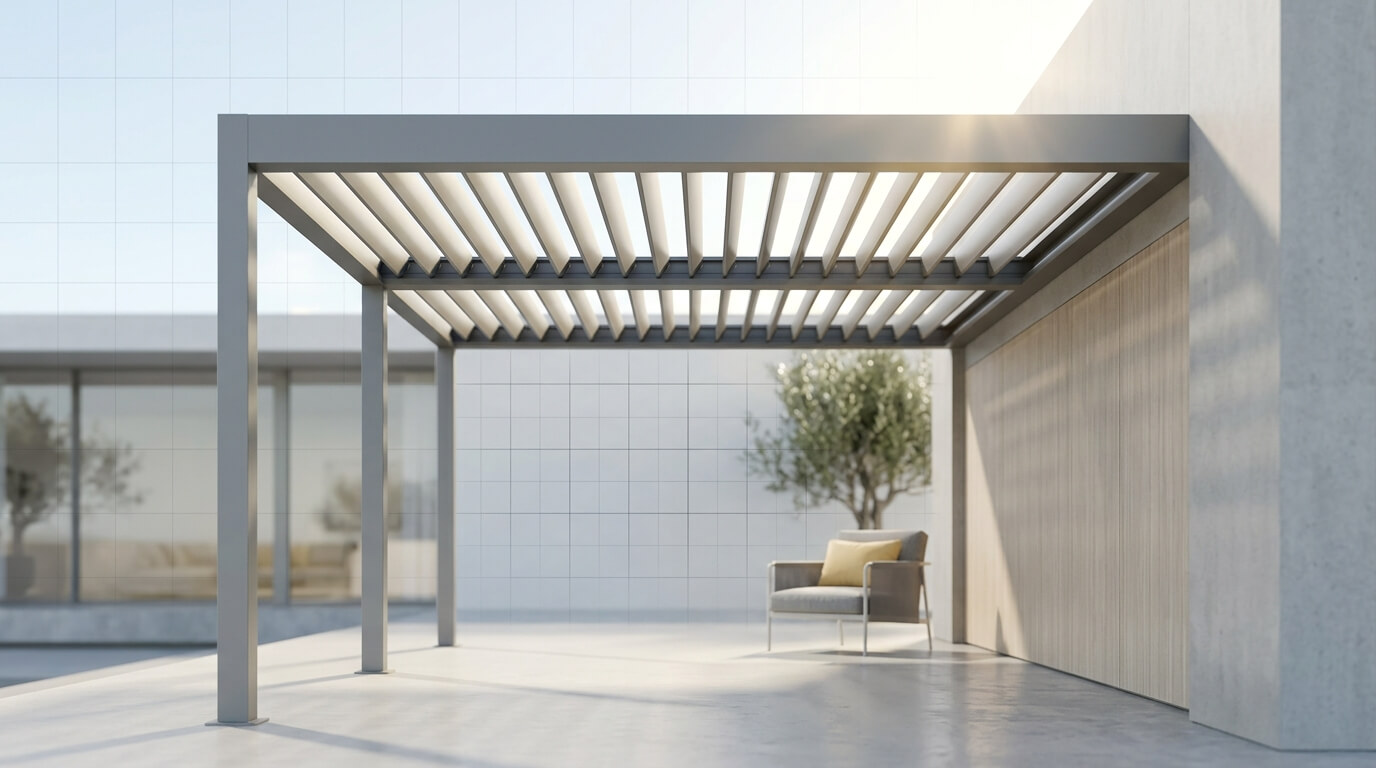
A pergola is one of the few home improvements that pays you back every single day of the year in Spain. It turns an unusable terrace into a shaded outdoor living room in July, keeps the rain off the table in November, and adds real value to a property in a market where outdoor space sells. But “pergola” now covers everything from a €2,000 fixed aluminium frame to a €12,000 motorised bioclimatic system with rain sensors, integrated LED lighting and side blinds — and the gap between a good and a bad installation is wide.
This guide walks through the real decisions: bioclimatic versus fixed, wall-attached versus freestanding, how the materials hold up under Andalusian sun and Mediterranean salt air, what permits and community rules apply, and what you should actually expect to pay per square metre in 2026. Estimia does not install pergolas — we verify the companies that do, so you can request and compare several quotes side by side instead of trusting a single salesperson.
Bioclimatic vs fixed aluminium: the core decision
Almost every modern pergola sold in Spain is aluminium-framed. The real fork in the road is what happens overhead.
Bioclimatic pergolas (motorised adjustable louvres / lamas orientables)
A bioclimatic pergola has a roof made of rotating aluminium blades, called lamas or láminas orientables. A motor tilts them anywhere from fully open (letting sun and breeze through) to fully closed (a watertight roof). This is the headline feature: you control sun, shade and ventilation through the day with a remote or an app, and the blades close automatically when a rain or wind sensor triggers.
- Sun control: angle the louvres to block midday sun while letting low winter light in — genuinely useful in central Spain and Andalusia where summer terraces are otherwise unusable from noon to evening.
- Rain control: closed louvres channel water into the perimeter beams and down hidden gutters in the posts. A well-built unit keeps a table dry in a Mediterranean autumn downpour.
- Ventilation: partially open blades vent hot air instead of trapping it, so you don’t get the greenhouse effect of a solid roof.
The trade-off is cost and complexity: motors, sensors and a control system mean more to specify correctly and more that can fail if installed badly. This is exactly where a verified installer matters.
Fixed aluminium pergolas
A fixed pergola has a permanent roof — either open slats for partial shade, or a solid/polycarbonate panel for full cover. There are no moving parts, so it is cheaper, simpler and very low-maintenance. The downside is that you give up control: a solid fixed roof shades beautifully but kills the winter sun you might want, while open slats look great but won’t keep you dry.
For many buyers a fixed pergola plus a retractable awning or a pergola with an integrated retractable fabric roof (a hybrid) is a sensible middle ground at a lower price than full bioclimatic.
| Feature | Bioclimatic (louvre) | Fixed aluminium |
|---|---|---|
| Adjustable sun/shade | Yes (motorised) | No |
| Rainproof | Yes, when closed | Only with solid roof |
| Ventilation control | Yes | No |
| Moving parts to maintain | Yes (motor, sensors) | Minimal |
| Typical price | Higher | Lower |
| Best for | Year-round outdoor room | Budget shade / simple cover |
Adosada vs freestanding (exenta)
Adosada (wall-attached) pergolas fix to the house wall on one side and stand on posts on the other. They are the natural choice for a terrace or back patio, use fewer posts, and read as an extension of the building. The catch: the wall fixing must be done into solid structure and properly sealed, because a poor fixing is the classic source of leaks and, on the coast, of corrosion staining down the façade.
Freestanding (exenta) pergolas stand on their own four (or more) posts anywhere in the garden — over a dining area, a hot tub, a poolside lounge. They are more flexible in placement but need their own foundations and, for larger spans, more posts or reinforced beams. Wind load matters more here: an exposed freestanding unit in a windy plot (think the Levante coast or inland Aragón) should be specified for the local wind zone, not bought off a generic spec sheet.
Lighting, sensors and side enclosures
The reason bioclimatic pergolas have become so popular is that the frame is a platform for a whole outdoor room:
- Integrated LED lighting runs inside the louvres or perimeter beams — dimmable strips or spotlights, usually app- or remote-controlled.
- Rain and wind sensors close the louvres (and retract any side blinds) automatically when you’re not home.
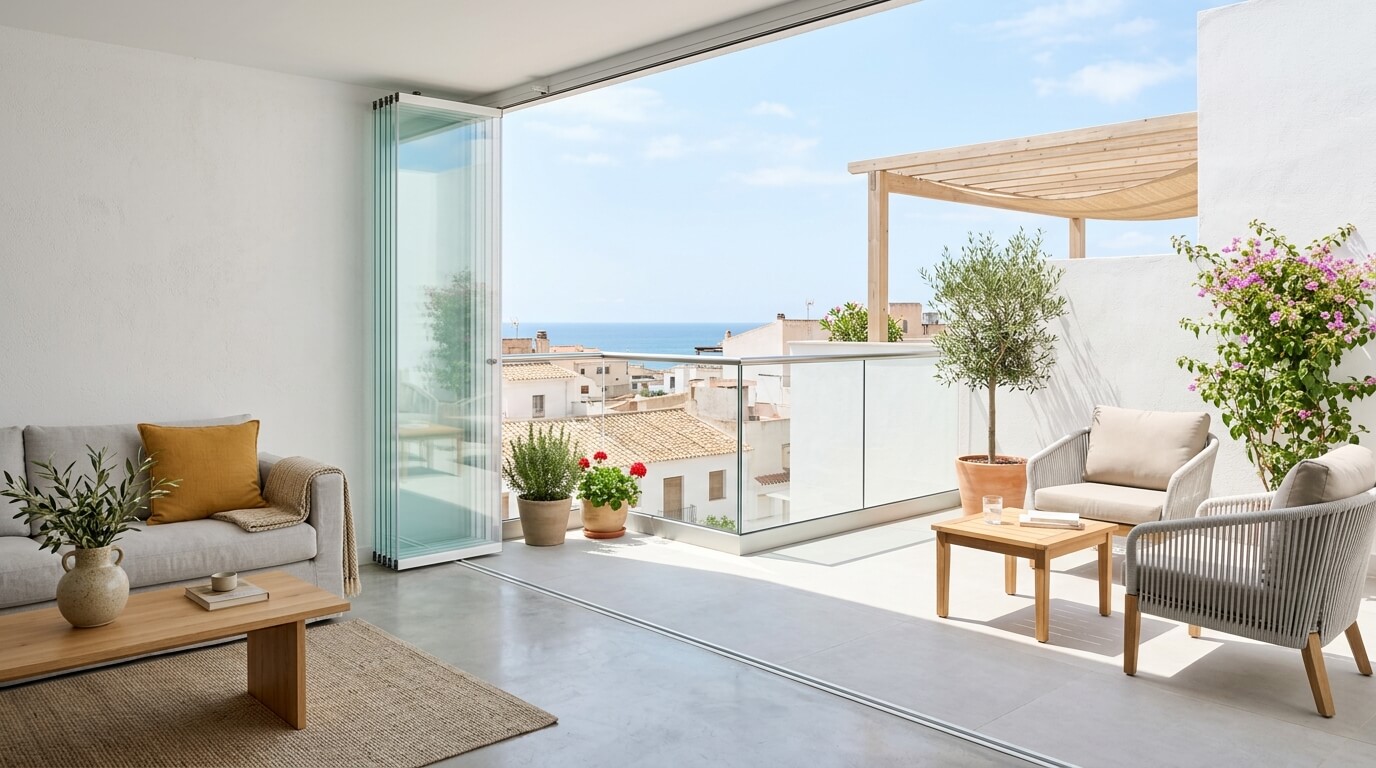
- Side blinds / glass curtains: vertical fabric screens (zip-guided to resist wind) or sliding glass panels close the sides, turning the pergola into a sheltered, near-enclosed space. Glass sides move you towards a true terrace enclosure — see our guide on glass curtains and terrace enclosures if you want a year-round room rather than seasonal shade.
- Heating: infrared heaters mount neatly to the frame for shoulder-season evenings.
Each addition is also a line on the quote, which is why two pergolas of the same size can differ by thousands of euros. When you compare quotes, make sure each one lists the same options so you’re comparing like with like.
Materials and durability in the Spanish climate
Spain is hard on outdoor structures, and the right specification changes by region.
- Aluminium grade and coating: quality pergolas use thermolacquered (powder-coated) aluminium. On the coast, ask for a marine-grade / “sea-side” coating spec — standard powder coat can chalk and pit within a few years in salt air on the Costa del Sol, Costa Blanca or the islands.
- Stainless fixings: screws and brackets should be stainless steel (A2, ideally A4/316 near the sea). Cheap zinc-plated fixings rust and bleed brown stains down white aluminium within a couple of seasons.
- UV and heat: Andalusian and Canary Islands sun fades cheap fabrics and degrades low-grade plastics fast. Specify UV-stable fabrics for blinds and quality gaskets; aluminium itself handles the heat well.
- Wind: the Mediterranean and Atlantic coasts get serious gusts. A reputable installer specifies the structure to the local wind zone and may add extra posts or thicker beams — don’t let anyone wave this away.
- Snow: only relevant inland and at altitude (Sierra Nevada, the meseta in a cold snap), but a closed bioclimatic roof must carry the load.
A well-made aluminium pergola should come with around a 10-year structural warranty and 2–5 years on motors and electronics. Get the warranty terms in writing and check who honours them.
Permits and community rules
This is where Spanish buyers most often get caught out.
- Licence: in most municipalities a fixed or bioclimatic pergola that is anchored to the ground or wall needs at least a declaración responsable or licencia de obra menor from the ayuntamiento. A purely removable, lightweight, unanchored structure may not — but rules vary by town hall, so confirm locally before you buy.
- Comunidad de vecinos: if you live in a flat or terraced house with a community of owners, a pergola on a terrace or patio almost always needs the community’s permission, especially when it’s visible from the street or affects the building’s appearance. Communities can impose colour and design rules. Get approval in writing first; retrofitting permission after installation is painful.
- Setbacks and heights: freestanding structures may have to respect distances from boundaries and maximum heights. Your installer should know the local norms, but the legal responsibility sits with you as the owner.
- Listed/protected zones: in historic centres (cascos históricos) and protected areas, expect stricter aesthetic controls.
A good company will tell you honestly what paperwork your project needs; a company that says “no need to worry about permits” is a red flag.
Price ranges in Spain (2026)
Pergolas are quoted per square metre, and the spread is large because of options, size and access. As a realistic 2026 guide:
| Type | Typical price (supplied & installed) |
|---|---|
| Fixed aluminium, open slats | €150–€300 / m² |
| Fixed aluminium, solid/polycarbonate roof | €250–€450 / m² |
| Bioclimatic, motorised louvres (basic) | €450–€700 / m² |
| Bioclimatic with lighting, sensors, side blinds | €700–€1,100+ / m² |
A typical 4 × 3 m (12 m²) bioclimatic pergola therefore lands somewhere around €6,000–€12,000 fully optioned. Watch for what’s excluded: electrical connection, foundations for freestanding units, glass or fabric sides, and the municipal licence fee are often quoted separately. Note also that some energy-efficiency and home-improvement incentives are time-limited — several NextGenerationEU-linked grant schemes are winding down through 2026 — so check current local programmes before assuming a deduction applies.
How to compare pergola quotes well
Three quotes for “a 12 m² aluminium pergola” can be impossible to compare unless you force them onto the same terms. Ask every company for:
- Exact spec: aluminium grade, coating (and marine spec if coastal), louvre type, motor brand, sensors included.
- What’s included vs extra: foundations, electrical hookup, sides, lighting, removal of old structure, the municipal licence.
- Wind/snow rating for your location.
- Warranty split between structure and electronics, and who services the motor.
- Lead time and who actually installs — subcontracted or in-house.
Conclusion
The right pergola depends on how you’ll use the space: a fixed aluminium frame is the value choice for simple shade, while a bioclimatic louvre system with sensors, lighting and glass sides turns a terrace into a genuine year-round room. Either way, the structure, coating and installation quality — not the brochure — decide whether you’re happy in five years’ time, especially on the coast.
Compare verified pergola companies on Estimia and request several quotes to weigh side by side. Every company on the platform is vetted before it can receive enquiries, so you can focus on the spec and the price rather than wondering whether the installer is trustworthy.