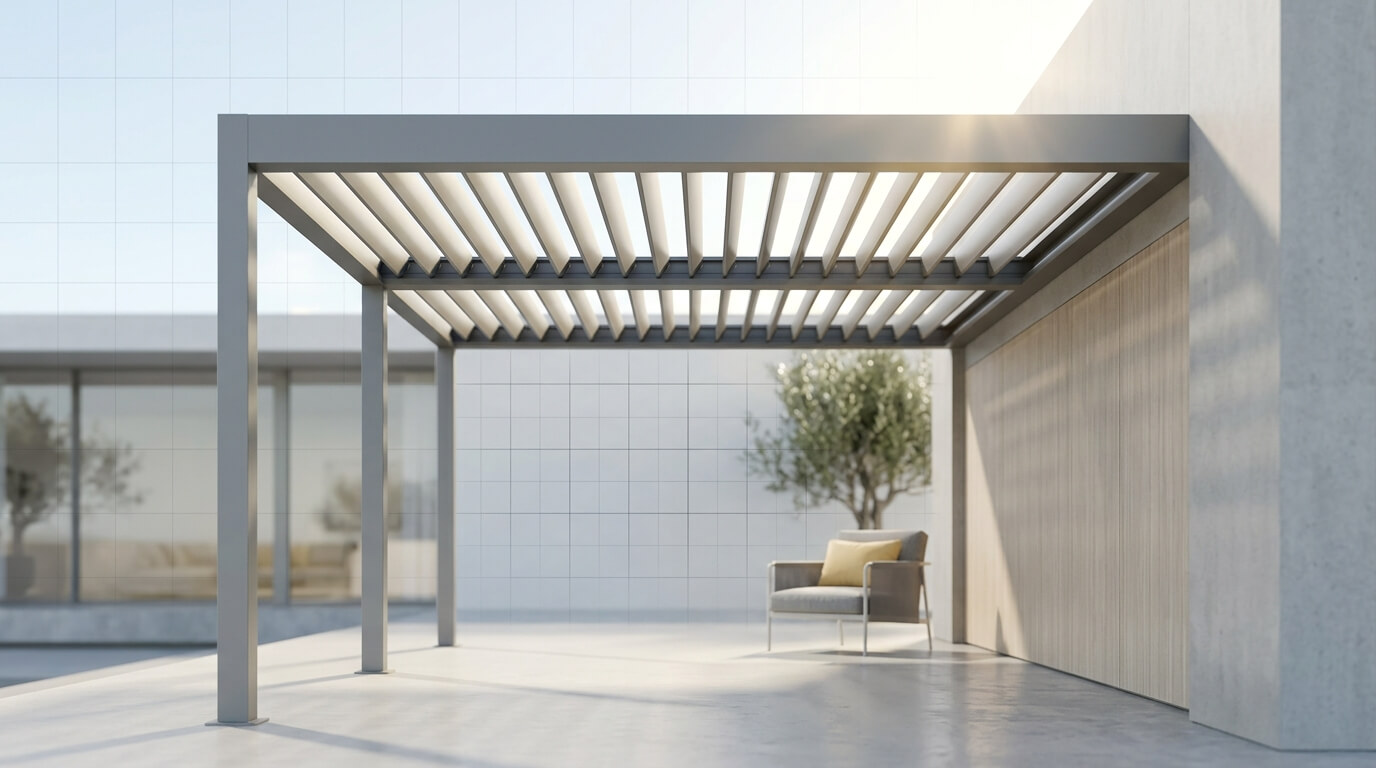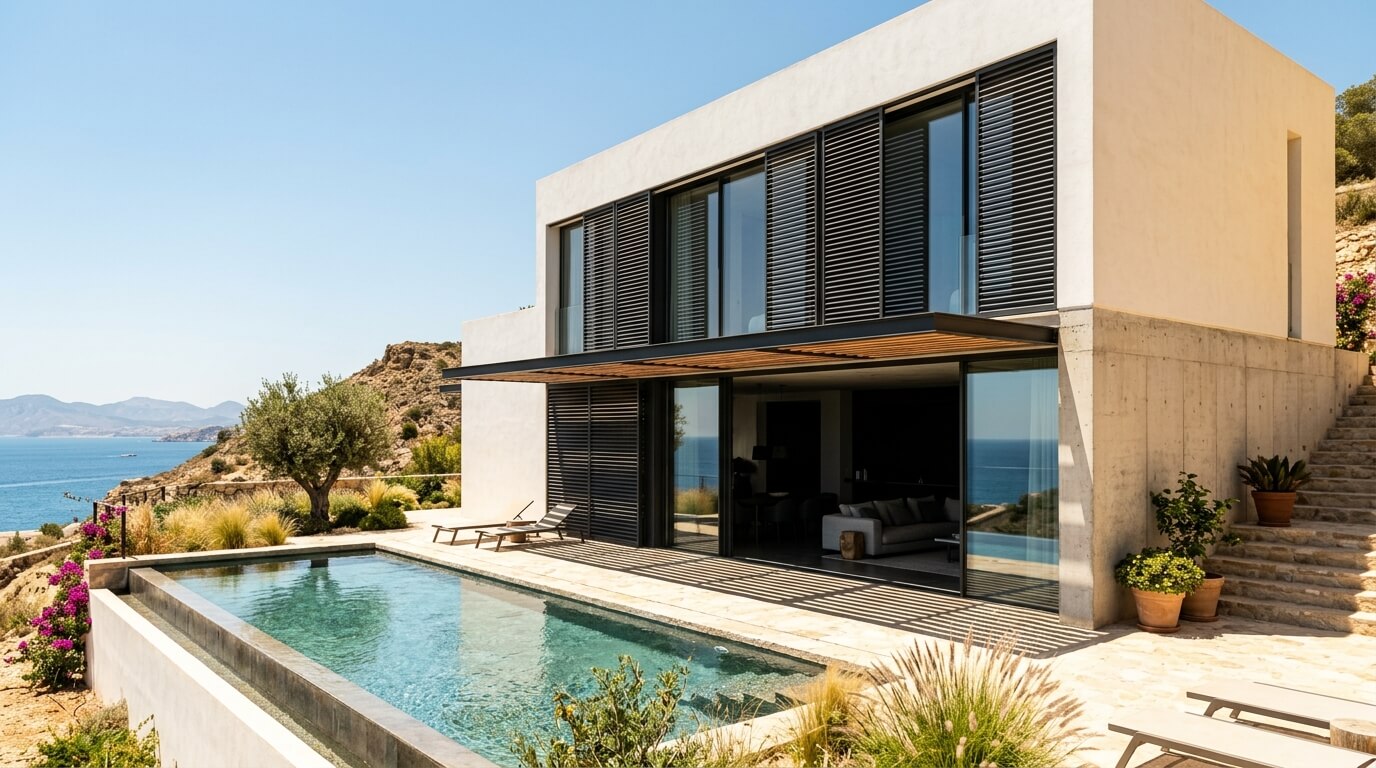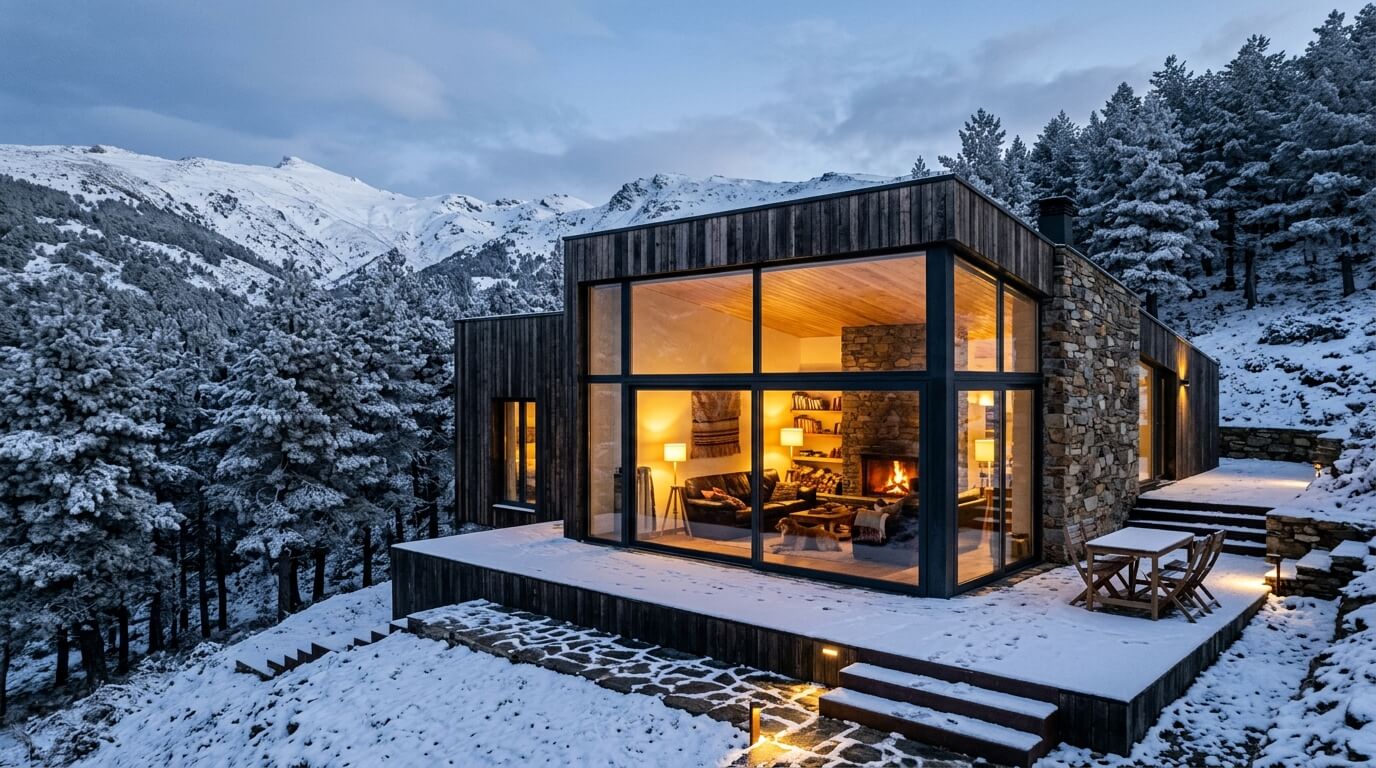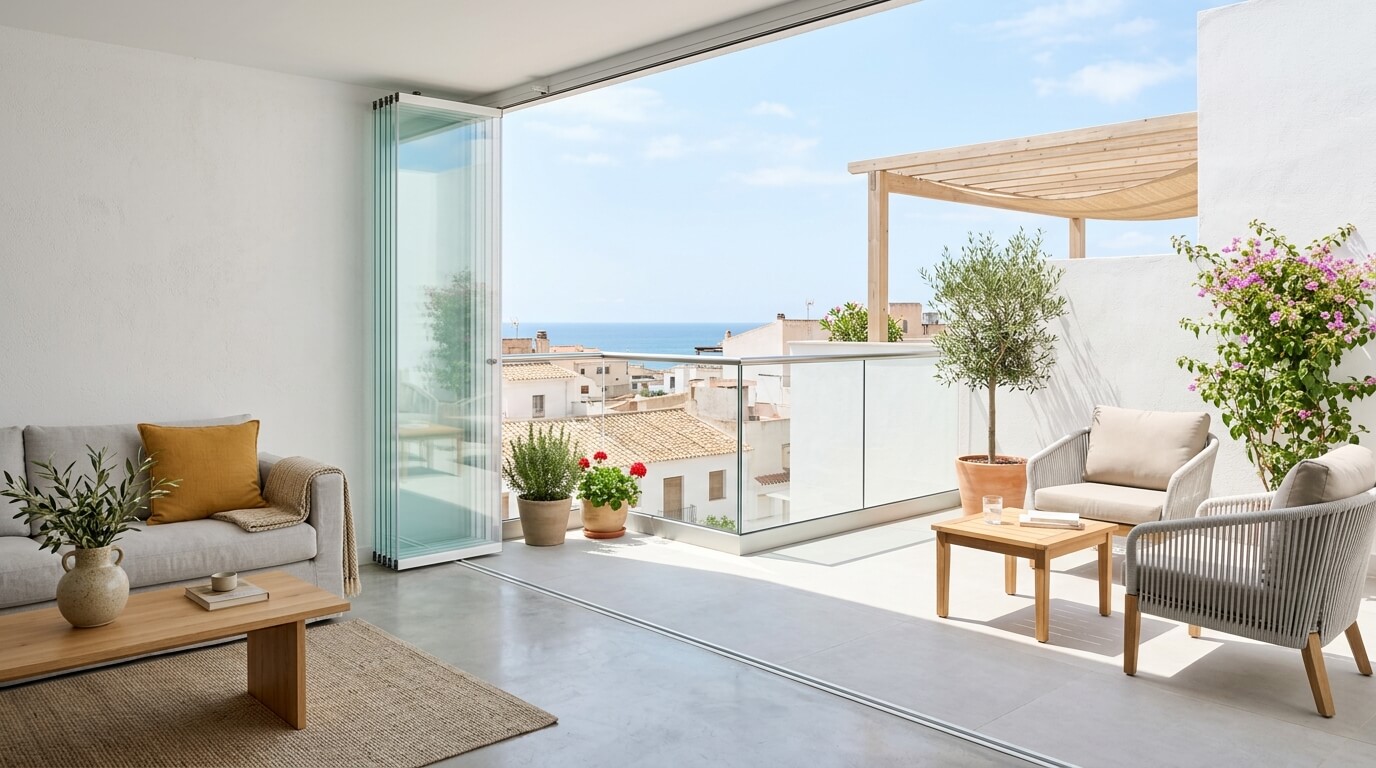
In Spain a terrace is too valuable to use for only half the year. The wind off the Mediterranean, an autumn shower, or simply the evening chill in central Spain is enough to push people back indoors and leave the best square metres of the home empty. Glass curtains (cortinas de cristal) and terrace enclosures (cerramientos) solve exactly that: they wrap the terrace in glass so you keep the view and the light but gain shelter, quiet and — with the right system — warmth.
The catch is that “enclosing the terrace” can mean very different products at very different prices, and the wrong choice (or the wrong paperwork with your comunidad de vecinos) is an expensive mistake. This guide explains frameless versus framed systems, sliding versus folding glass, thermal versus non-thermal, the condensation question nobody mentions in the showroom, and realistic 2026 prices per square metre. Estimia doesn’t install enclosures — we verify the companies that do, so you can compare several quotes side by side.
The two families: glass curtains vs framed enclosures
Frameless glass curtains (cortinas de cristal)
A glass curtain is a system of tempered glass panels that slide along top and bottom tracks and then pivot and fold back to one side, stacking like the pages of a book. There are no vertical aluminium frames between the panels — just slim joints — so when closed you get an almost uninterrupted glass wall, and when open you can fold the whole side away and have a fully open terrace again.
Strengths: panoramic, minimalist, lets you switch between “open terrace” and “sheltered room” in seconds. This makes them hugely popular on the coast and for hospitality terraces.
Limitations: a frameless glass curtain is a wind and rain break, not an airtight wall. The panels meet with brush or fin seals, not thermal gaskets, so they block wind, dust, noise and most rain — but they are not thermally insulating and won’t keep a room genuinely warm in winter on their own. They are non-thermal by nature.
Framed terrace enclosures (cerramientos con perfilería)
A framed enclosure uses aluminium profiles around each glazed unit — essentially extending the building’s window system across the terrace. These can be sliding, folding (an accordion/folding door), or fixed glazing with opening sections. Because each pane sits in a proper frame with gaskets, framed enclosures can be sealed far better and, crucially, can be thermally broken (see below).
Strengths: much better sealing, security and insulation; can use double glazing; behaves like a real extension of the home.
Limitations: the visible frames break up the view compared with frameless curtains, and a fully sealed enclosure of a terrace may legally count as enclosing/extending habitable space — which has planning and community implications.
Sliding vs folding glass
Within both families you’ll choose how the glass moves:
- Sliding (corredera): panels slide horizontally past each other. Easy daily use, takes no swing space, but you can only ever open part of the width. For large openings, lift-and-slide (elevadora) systems carry heavy panels smoothly and seal tightly when lowered — see our guide on large sliding doors for the same technology applied to the main façade.
- Folding (plegable / book system): panels concertina to one side, opening up to ~90% of the span. This is how glass curtains work and is the choice when you want the terrace to disappear entirely on a good day.
A common pattern: a frameless glass curtain across the open front for the view and the “fold it all away” effect, with a framed thermal section where the terrace meets a bedroom or living room.
Thermal vs non-thermal: the decision that drives comfort and price
This is the single most important technical choice.
- Non-thermal (frameless glass curtains, single glazing, basic aluminium): blocks wind and rain, dramatically improves usability, but transmits heat and cold. In a hot summer the closed space heats up; in winter it stays close to outdoor temperature. Perfect for extending the season; not a true winter room.
- Thermal (rotura de puente térmico + double glazing): a thermally broken aluminium profile puts an insulating barrier inside the frame, and double glazing cuts heat loss. This is what lets an enclosure behave like a heated room with a sensible energy bill, reaching window-grade Uw values around 1.3–2.0 W/m²K depending on the system, versus much higher (poorer) figures for single-glazed frameless curtains.
A rough rule for Spain by climate:
| Region | Typical sensible choice |
|---|---|
| Mediterranean coast (Costa Blanca/del Sol) | Frameless glass curtain or non-thermal framed — mostly wind/rain shelter |
| Central Spain / meseta | Thermal framed enclosure with double glazing for real winter use |
| Galicia / Basque north | Thermal, well-sealed — wind and persistent rain |
| Canary Islands | Frameless/non-thermal usually enough; prioritise ventilation |
Wind, rain and the condensation question
Closing a terrace introduces a problem few buyers think about until it’s too late: condensation. When you seal a cooler outdoor space and then occupy it, warm moist air hits cold glass and water forms — running down panes, pooling on tracks, and over time encouraging mould. Mitigate it by:
- choosing double glazing (the inner pane stays warmer, so it condenses less),
- ensuring the system has controlled ventilation (trickle vents or simply being able to crack a panel),
- including drainage in the bottom track so any water that does form drains out rather than sitting in the frame.
For wind and rain, ask specifically how the system performs in your exposure. Frameless curtains handle gusts and driving rain well when the seals are good and the tracks drain, but a cheap installation with poor brush seals will whistle and leak. A verified installer will spec the right system for an exposed Levante or Atlantic plot rather than a generic one.
Permission from your community of owners
In a block of flats or a townhouse with a comunidad de vecinos, enclosing a terrace is rarely a free choice, because the terrace is usually part of the building’s exterior appearance.
- Aesthetics rule: Spanish horizontal-property law lets communities require that exterior changes don’t alter the building’s appearance. Many communities pass a rule fixing one approved enclosure system, profile colour and glass type so every terrace matches — and they can require you to use it.
- Approval: you generally need the community’s authorisation, often by a qualified majority at a junta. Enclosing without it risks the community demanding removal at your expense.
- Town hall: a framed, sealed enclosure that effectively creates new habitable space can also need a municipal licence and may even affect the property’s registered surface and rateable value.
The order to follow: check the community’s rules and statutes → get written approval → confirm the municipal licence → then sign for the work. A reputable company will ask about your community situation; one that brushes it aside is risking your money.
Prices in Spain (2026)
Enclosures are quoted per square metre of glazed area and vary widely with system and glass:
| System | Typical price (supplied & installed) |
|---|---|
| Frameless glass curtain (single tempered, non-thermal) | €250–€450 / m² |
| Framed sliding, non-thermal | €300–€500 / m² |
| Framed folding/sliding, thermal break + double glazing | €450–€800+ / m² |
| Lift-and-slide thermal, large panels | €600–€1,000+ / m² |
A typical 10–12 m² terrace front therefore ranges from roughly €3,000 for a basic glass curtain to €8,000+ for a fully thermal enclosure. Toughened/laminated safety glass, motorisation, and difficult access (high floors, no lift) push costs up. Some energy-efficiency incentives tied to glazing upgrades exist but are time-limited — several NextGenerationEU-linked schemes are winding down through 2026 — so check what’s currently available locally rather than assuming a deduction.
How to compare enclosure quotes
Force every quote onto the same terms before comparing:
- System type: frameless vs framed, sliding vs folding, thermal vs non-thermal.
- Glass: thickness, tempered vs laminated, single vs double, and Uw if thermal.
- Sealing and drainage: brush vs gasket seals, drained tracks.
- What’s included: removal of old screens, electrical (if motorised), the licence, finish/colour to match community rules.
- Warranty on glass, hardware and seals.
Conclusion
A terrace enclosure can add a whole room’s worth of usable space to a Spanish home — but only if the system matches how you’ll use it. Choose a frameless glass curtain for breezy seasonal shelter and the view; choose a thermal framed enclosure when you want a genuinely warm winter room. And in any community of owners, sort the permission and aesthetics rules before anything else.
Compare verified terrace-enclosure and glass-curtain companies on Estimia and request several quotes to weigh side by side. Every company on the platform is vetted before it can receive enquiries, so you can compare specifications and prices with confidence.