If you are about to replace the windows in a Spanish home, the first question is always the same: how much will it cost? And the honest answer is that there is no single figure — the price of a window in Madrid is not the price of the same window in Marbella, a third-floor flat with no lift is not a ground-floor villa, and a basic double-glazed unit is not a triple-glazed acoustic one. What you can have, though, is a reliable price-per-square-metre framework that tells you whether a given quote is cheap, fair or inflated, and what you are actually paying for.
This guide is the Spain-2026 reference for that. We cover real installed €/m² ranges for PVC, aluminium and wood, the factors that move the price, worked totals for a typical flat versus a villa, and the trap almost every homeowner falls into — assuming the lowest number on the page is the best deal. Crucially, the ranges below aren’t pulled from the air: they’re calibrated against real 2026 factory price lists from a verified manufacturer on the platform — actual euros for actual sizes — which you can browse in full on our 2026 window price list. Estimia exists precisely so you don’t have to take any single installer’s word for it: you can request and compare several verified, like-for-like quotes in one place.
Installed price per m² in 2026 (the headline numbers)
The figures below are fully installed, including the new window, standard double glazing, basic delivery and fitting, and IVA at the reduced rates that usually apply to home renovation work. They are realistic market ranges for mainland Spain in 2026; the coast and the big cities sit at the upper end, smaller towns at the lower end.
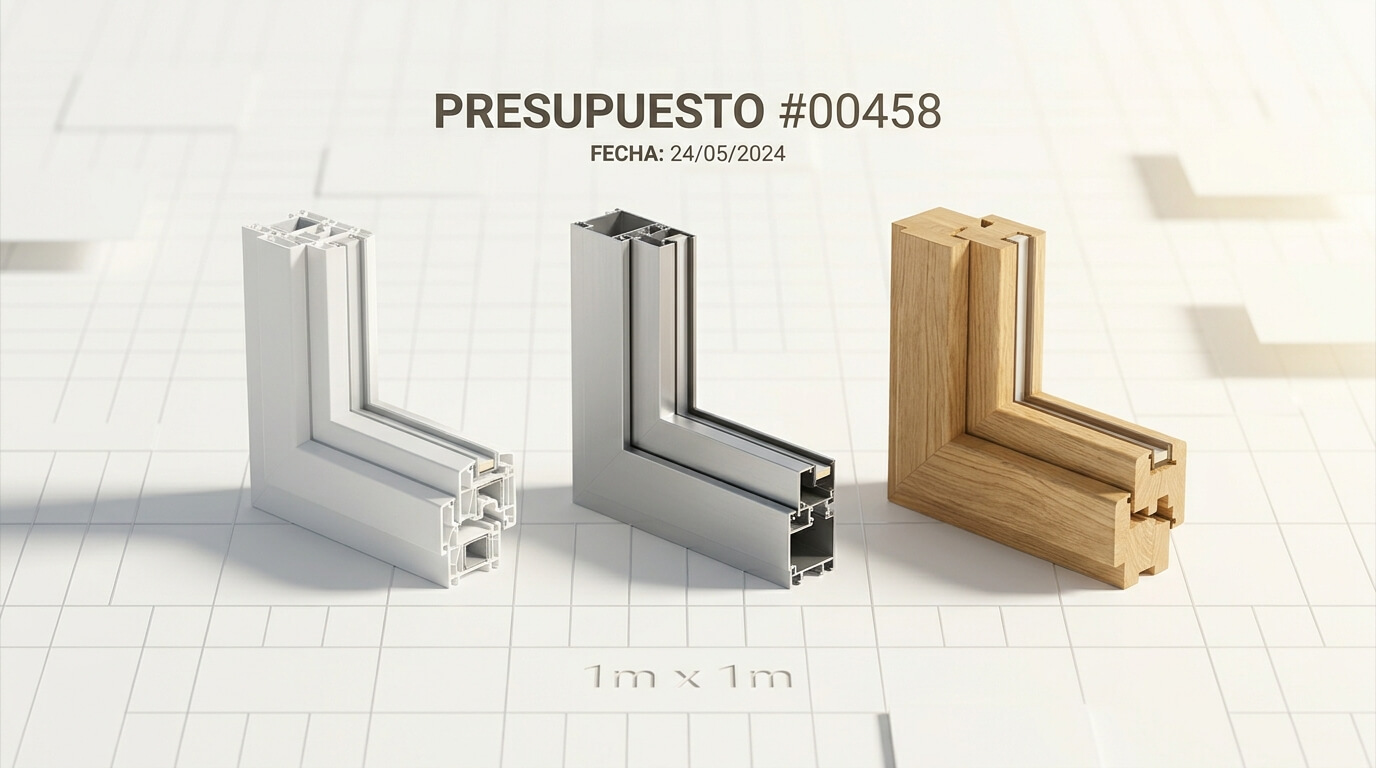
| Frame material | Installed €/m² (typical) | Best for |
|---|---|---|
| PVC | €280 – €480 | Best price-to-performance; great thermal and acoustic insulation |
| Aluminium (thermal break) | €350 – €650 | Large openings, sliding doors, slim sightlines, durability |
| Aluminium (no thermal break) | €180 – €300 | Cheap, but poor insulation — avoid for habitable rooms |
| Wood | €550 – €1,100+ | Heritage buildings, premium aesthetics, listed façades |
| Wood-aluminium composite | €700 – €1,300+ | Warmth of wood inside, weatherproof aluminium outside |
A few things to read into that table immediately:
- PVC is the value champion in most of Spain. For a standard residential refurbishment it usually delivers the best insulation per euro.
- Cheap aluminium without a thermal break still exists and is still sold. It is fine for an unheated garage or a storeroom, but for a living room it will condense, leak heat and undo much of the point of replacing your windows. If a suspiciously low aluminium quote lands on your desk, check this first.
- Wood is a premium, not a default. You generally choose it for character or because a comunidad or heritage rule requires it, not to save money.
From factory price to installed price (real 2026 numbers)
The €/m² ranges above are installed figures, and they hide a useful fact: the window itself is often the smaller half of the bill. To show where the money goes, here are real supply prices — what the factory charges for the unit alone, before VAT and before anyone fits it — for the three systems most Spanish homes actually buy. All are quoted with a standard 4/16/4 double-glazed unit.
| Window (tilt & turn, 1 sash) | Standard PVC Rehau EURO 70 · Uw 0.99 | Premium PVC Rehau SYNEGO · Uw 0.80 | Thermal-break aluminium Cortizo COR 70 · Uw 1.4 |
|---|---|---|---|
| 60 × 60 cm (0.36 m²) | €130 | €201 | €368 |
| 100 × 100 cm (1.0 m²) | €195 | €297 | €504 |
| 120 × 120 cm (1.44 m²) | €262 | €355 | €613 |
| 140 × 140 cm (1.96 m²) | €332 | €420 | €730 |
Two things jump out of that table — and both explain the spread in the €/m² ranges:
- Per square metre, small windows are brutal. That 60 × 60 standard-PVC window is €130, which works out to about €360/m² of supply. The 140 × 140 is €332 — only €170/m². Same profile, same glass, less than half the per-m² rate. It is the single biggest reason a bathroom window feels “overpriced” and a whole-home job feels like a bargain.
- Material is a multiplier, not a tweak. At 100 × 100 the same tilt-and-turn runs €195 in standard PVC, €297 in premium PVC, €504 in aluminium — and notice the PVC has the lower Uw. You are paying for aluminium’s slim sightlines and strength on big openings, not for better insulation.
So how does €195 become an installed figure?
Take that 100 × 100 standard-PVC window and walk it to the invoice:
- Window, supplied: €195
- Installation + removal of the old unit: roughly €110
- IVA at the reduced 10% renovation rate: about €30
- Installed total: ≈ €335 — i.e. ~€335/m², squarely inside the €280–480/m² PVC band above.
Add a built-in monoblock shutter (a persiana integrated into the frame) and that’s another €180 on this size before fitting. Want the same breakdown for your exact sizes and opening types? The full, size-by-size 2026 price list lays out fixed, casement, tilt-and-turn and sliding prices for all three systems, balcony doors, bi-folds and minimalist glass walls.
What the price actually depends on
Two homes can get quotes that differ by 60% for windows that look identical in a brochure. Here is what is driving that gap.
1. Size and number of openings
Price scales with glass and frame area, but not linearly — there is a fixed cost to every visit, measurement and installation day. Replacing one window is disproportionately expensive per m²; replacing all of them at once is far cheaper per unit. This is why a whole-home quote almost always beats piecemeal replacement.
2. Opening type
A fixed pane is the cheapest thing in the catalogue. A tilt-and-turn (oscilobatiente) costs more because of the hardware. Sliding and lift-and-slide systems for terraces are more again. The gap is real and measurable: at 100 × 100 in standard PVC the same opening runs roughly €91 fixed → €195 tilt-and-turn → €329 sliding at the factory. And large minimalist glass walls are in a different league entirely — a slim-framed Cortizo COR VISION sliding wall starts around €2,775 for a modest two-panel unit and climbs past €17,000 for an 11-metre, four-panel span. One or two of those are usually what turns a villa quote into a five-figure number.
3. Glazing specification
This is where a lot of hidden money lives:
- Standard double glazing is the baseline.
- Low-emissivity (bajo emisivo) and solar-control coatings matter enormously in Andalusia and the Mediterranean coast, where the problem is keeping heat out.
- Acoustic glass (asymmetric laminated panes) adds cost but is essential on busy streets — it can take you from roughly 30 dB to 40+ dB of reduction.
- Triple glazing makes sense in the cold interior (the meseta) and the northern Atlantic strip (Galicia, the Basque Country), and is usually overkill on the warm coast.
4. Hardware and the Uw value
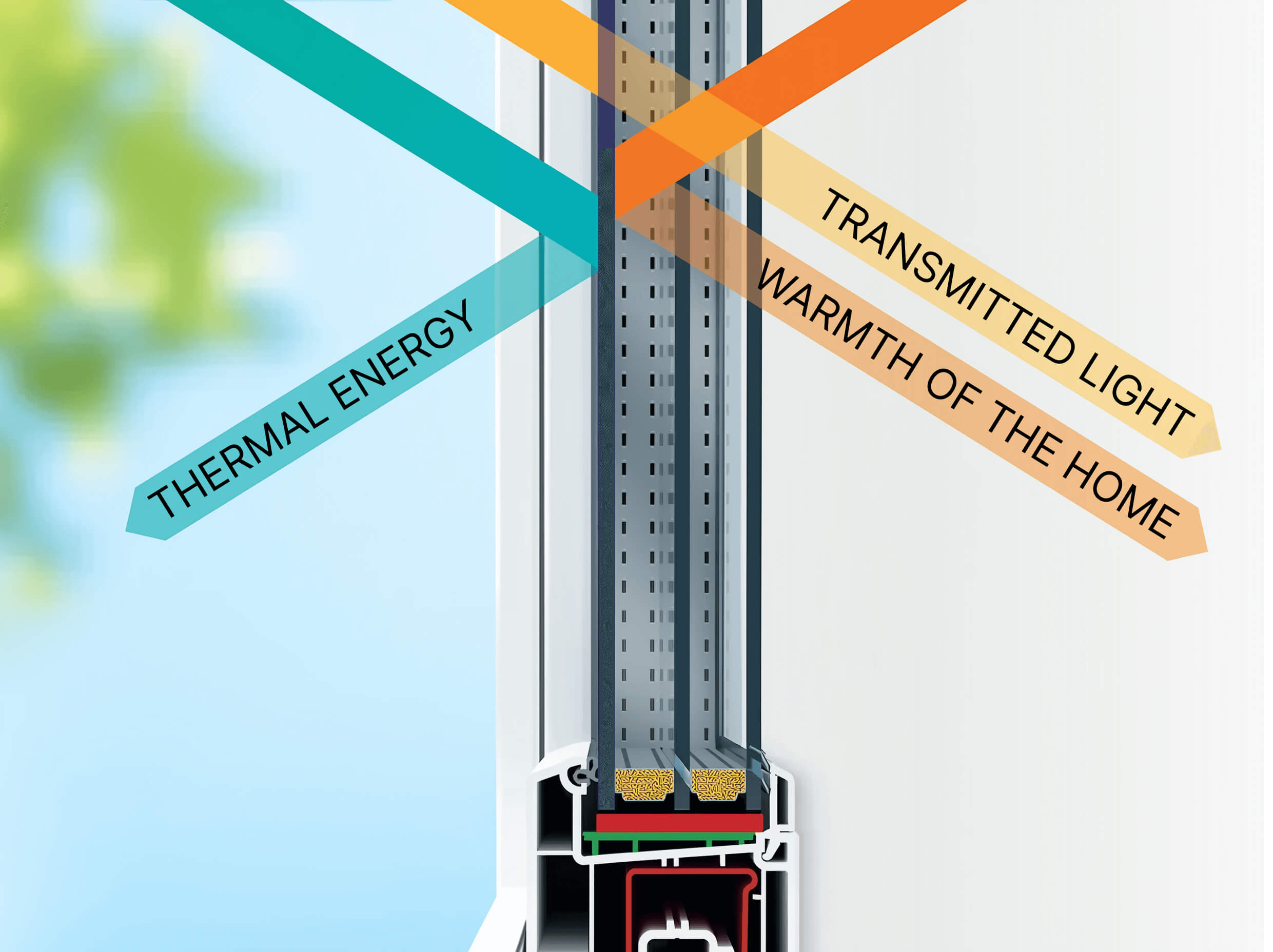
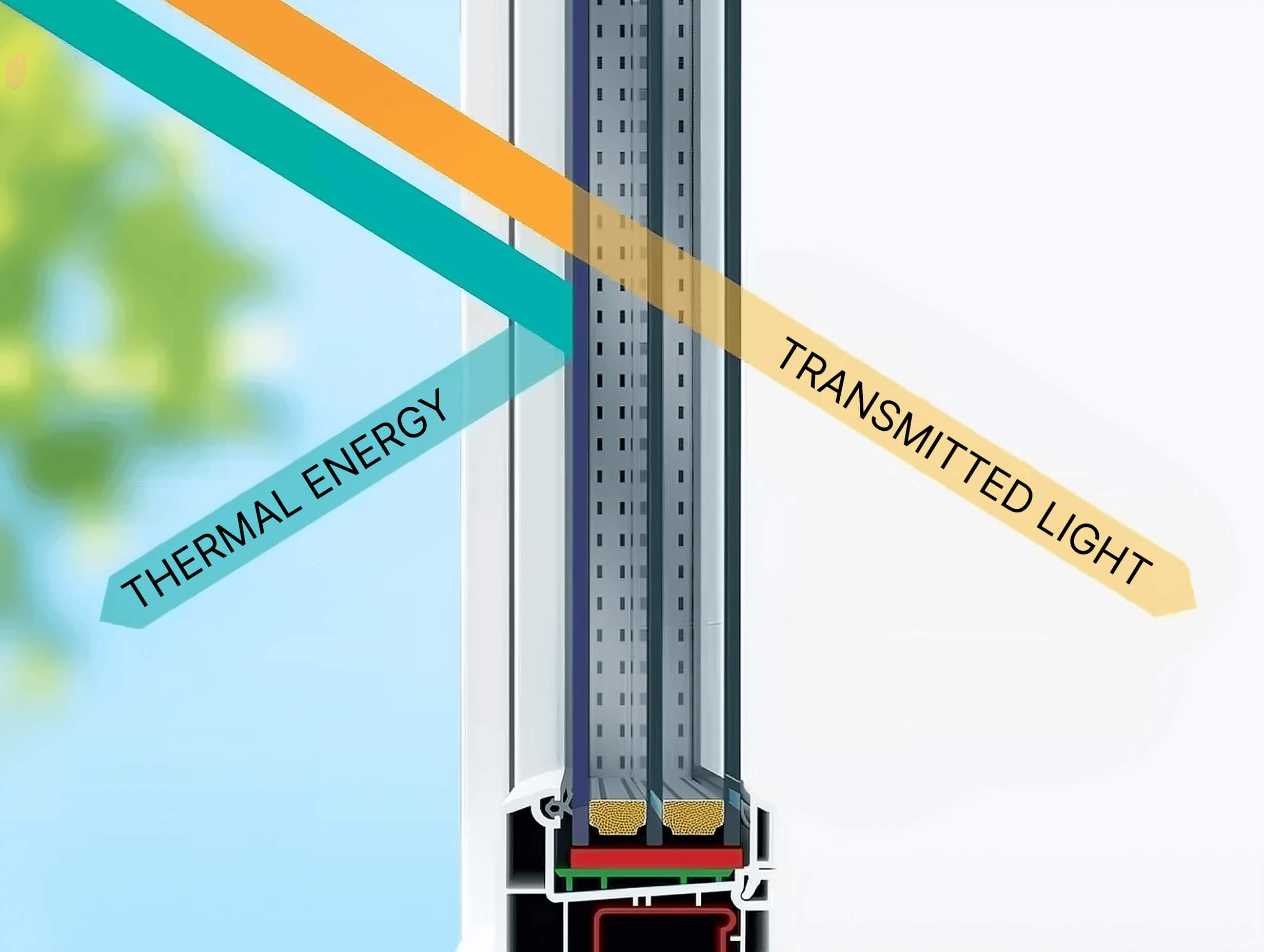
The Uw value (whole-window thermal transmittance, in W/m²K) is the single number that summarises insulation — lower is better. A modern PVC window lands around Uw 1.0–1.3, premium triple-glazed units below 0.9, while old aluminium can be Uw 5+. Better hardware, more spacer chambers and warm-edge spacers all push Uw down and price up. If you want the detail behind that number, see our dedicated guide on the Uw value.
5. Installation complexity and access
Often underestimated:
- Floor and access: a sixth floor with no lift, or a façade needing a góndola or scaffolding, adds real cost.
- Wet vs dry installation: removing the old frame entirely and re-rendering the reveal (the correct, durable method) costs more than fitting over the existing frame.
- Removal and disposal of the old windows and the escombros — this should be a line item, not a surprise.
- Persianas (blinds), mosquiteras and reveals: replacing or adapting these adds up.
Worked examples: flat vs villa
Numbers make this concrete. These are illustrative whole-home jobs at mid-market PVC pricing, fully installed.
Typical flat — 80 m² apartment, 6 openings
- 5 tilt-and-turn windows + 1 small terrace sliding door
- Roughly 14 m² of total window area
- Standard double glazing, low-E coating, one acoustic upgrade on the street-facing room
- Estimated total: €5,000 – €8,500
A flat is usually the more cost-efficient job per m²: openings are smaller, access is via the building, and the work is done in a day or two.
Detached villa — 200 m² house, 14 openings
- Mix of tilt-and-turn windows, two large lift-and-slide terrace doors, fixed panes
- Roughly 35–40 m² of total window area
- Thermal-break aluminium on the big sliding spans, PVC elsewhere, solar-control glass
- Scaffolding for the upper floor
- Estimated total: €18,000 – €35,000+
The villa’s per-m² cost is higher because of the large sliding doors, the access requirements and the premium glazing — exactly the factors from the section above, made visible. Put real numbers on it and the maths is obvious: two minimalist COR VISION glass walls of around 4 m each are roughly €7,000–€9,500 in supply alone, each, before installation and VAT. Two of them can account for half the entire villa budget on their own — which is why where you spend matters as much as how much.
Why the cheapest quote is rarely the best
When three quotes come in at €6,200, €5,900 and €3,400, the temptation is obvious. But a quote that is 40% below the others is almost never the same product. Usually one or more of these is true:
- Cheaper aluminium without a thermal break, or a PVC profile with fewer chambers and a worse Uw.
- Glazing downgraded — standard double instead of low-E or acoustic.
- Installation not included, or “fitting over the old frame” instead of a proper replacement.
- Removal, disposal, persianas or IVA excluded from the headline figure and added later.
- An uninsured or subcontracted crew with no written installation warranty.
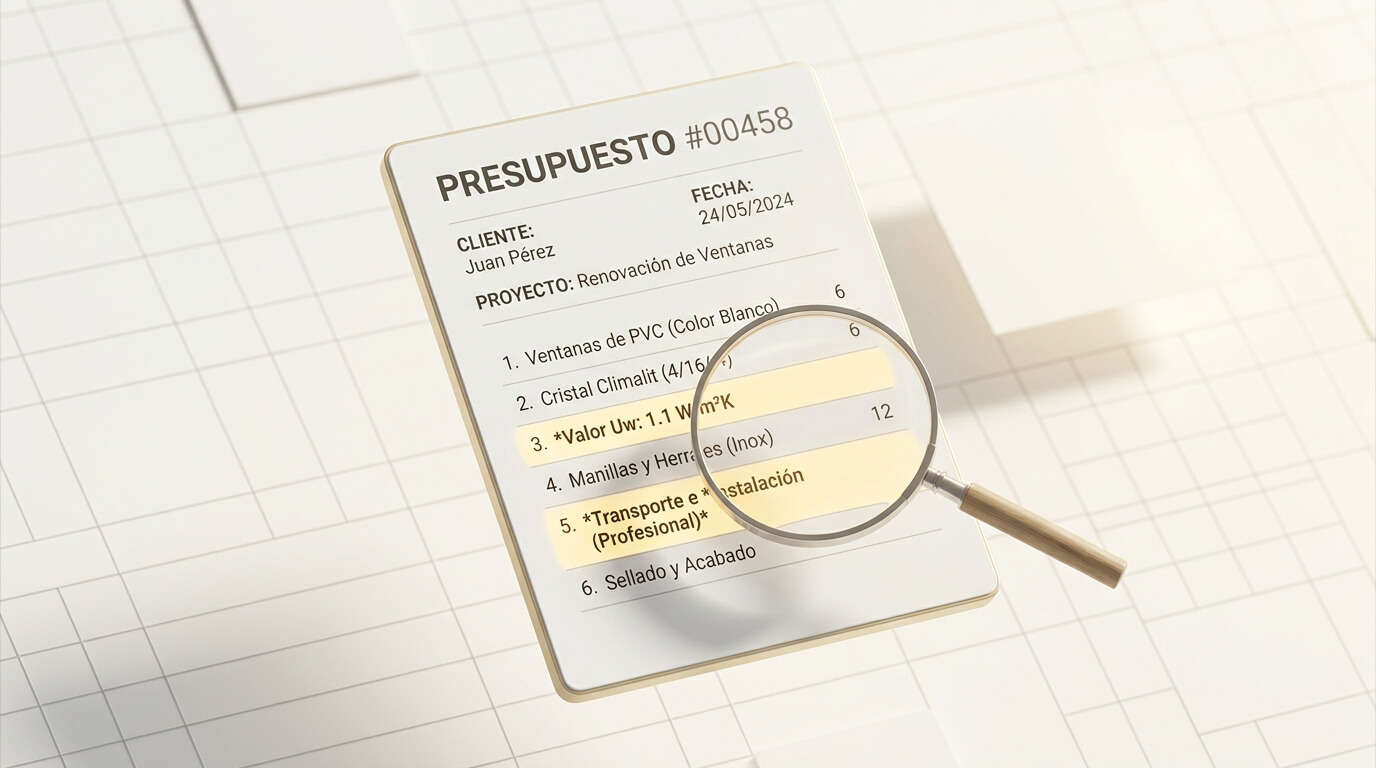
The cheapest quote frequently becomes the most expensive one once condensation, draughts or a leaking reveal appear two winters later. The point is not to chase the highest price either — it is to compare like with like. Our guide on how to compare window quotes breaks down line by line what must match before two numbers can honestly be set against each other.
How to get comparable quotes the easy way
The hard way is to find installers one by one, chase each for a site visit, and then try to reconcile three documents written in three different formats. The easy way is to let the comparison be structured for you.
On Estimia you can request quotes from several verified window companies near you and see them side by side. Every company on the platform is vetted before it can receive an enquiry, so you are comparing proven installers rather than gambling on whoever answered the phone. Because the requests are structured around the same specification — material, glazing, Uw, installation scope — the quotes that come back are genuinely comparable, which is exactly what turns a confusing price range into a confident decision.
Conclusion
Budget around €280–€480/m² installed for PVC, more for thermal-break aluminium and considerably more for wood, then adjust for glazing, access and complexity. A typical flat lands in the €5,000–€8,500 range; a villa with large terrace doors can run €18,000–€35,000+. If you want to sanity-check any quote against real factory prices before you even pick up the phone, our 2026 window price list gives you supply prices for every common size and system. The single most useful thing you can do is stop comparing prices in isolation and start comparing identical specifications from companies you can trust.
Compare verified window companies on Estimia and get several like-for-like quotes side by side — it is the fastest way to know whether the number in front of you is genuinely a good price. Once you have your quotes, read our guides on how to compare window quotes and how to choose a window company before you sign.