The question every homeowner asks after choosing a window is “when will it be done?” — and the honest answer is rarely the one they expect. The day the crew spends in your home is the short part. The waiting happens before that, in measurement and manufacturing, and most of the timeline you can’t see. People who budget a weekend and end up waiting six weeks aren’t victims of a slow installer; they simply didn’t know how the process is sequenced.
This guide lays out the full journey from quote to aftercare, with realistic durations for Spain in 2026, the seasonal factors that speed it up or slow it down, and how many days the actual work takes per window and per home. Knowing the shape of the process also makes you a better client: you’ll know when a promised timeline is reasonable and when it’s a red flag. And because Estimia lets you gather several verified quotes at once, you can compress the slowest early stage — the hunt for trustworthy installers — into a few days.
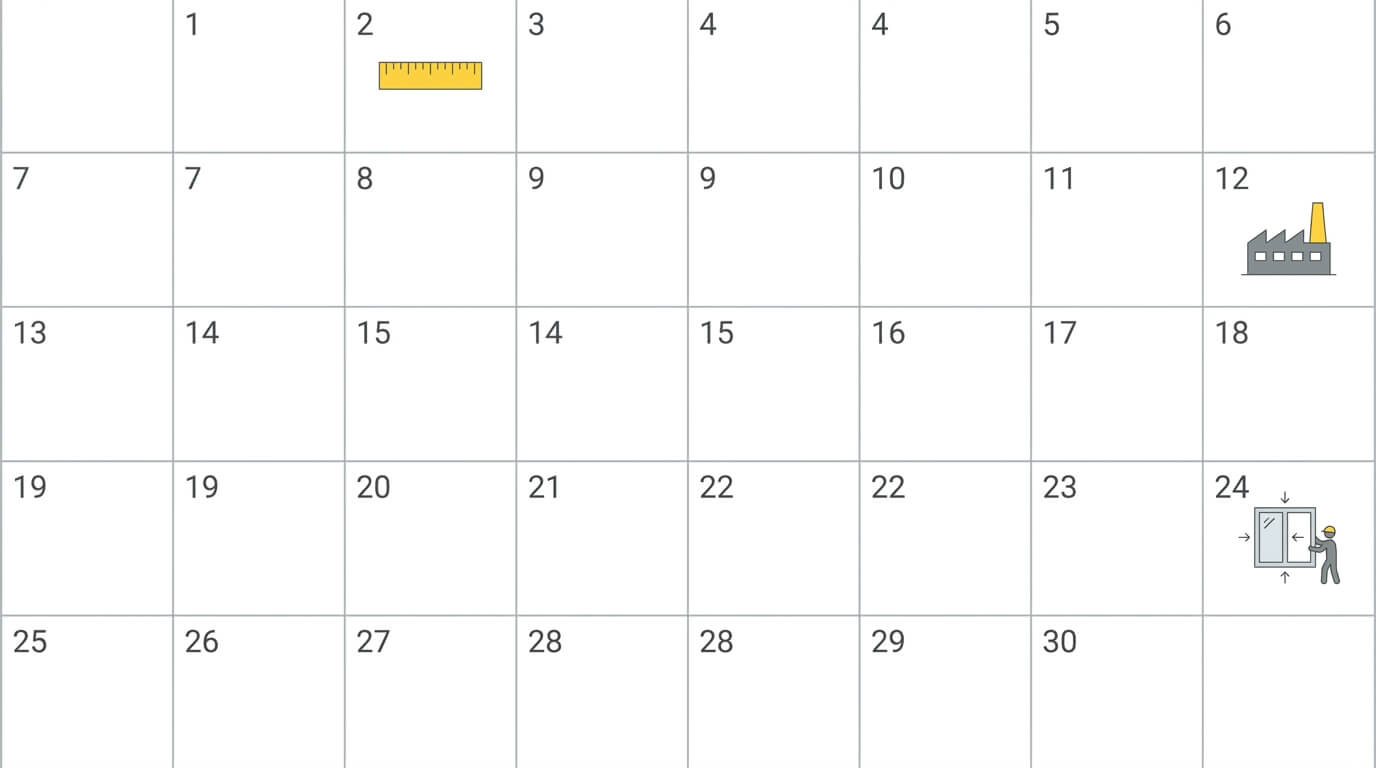
The full process at a glance
| Stage | Typical duration | Notes |
|---|---|---|
| 1. Quotes & comparison | 1–2 weeks | Faster if you request several at once |
| 2. Site measurement | 1 visit (~1 hr) | The make-or-break step for fit |
| 3. Manufacturing lead time | 3–6 weeks | The longest wait; the bottleneck |
| 4. Delivery & scheduling | A few days | Coordinated with the crew |
| 5. Removal of old windows | ½–1 day per home | Done the same day as fitting |
| 6. Installation | A few hrs per window | 1–2 days for a typical flat |
| 7. Finishing & sealing | Same/next day | Reveals, sealant, persianas |
| 8. Snagging & sign-off | Same day | Your inspection |
| 9. Warranty & aftercare | Ongoing | Keep the paperwork |
Total, quote to finished job: typically 5–9 weeks, the great majority of it manufacturing lead time you spend doing nothing but waiting.
Stage 1 — Quotes and comparison (1–2 weeks)
The slowest avoidable stage. Finding installers one by one, chasing each for a site visit and then trying to reconcile three quotes written three different ways can drag on for weeks. Request several quotes in parallel and structure them around the same specification — material, glazing, Uw, installation scope — and this collapses to a few days. Our guide on how much window replacement costs in Spain explains the €/m² framework you’ll use to judge whether each quote is fair.
Stage 2 — Site measurement (one visit)
A professional measures the actual openings on site — not from old drawings or a phone photo. This single visit determines whether the frames will fit with a correct, sealable perimeter gap. Getting this wrong is the root of several installation failures (frames too tight to expand, gaps too large to seal), so it’s a stage worth taking seriously. It takes about an hour for a flat. Manufacturing only starts once these final measurements are confirmed.
Stage 3 — Manufacturing lead time (3–6 weeks)
This is the bottleneck, and it’s the one homeowners consistently underestimate. Windows in Spain are made to order, not pulled off a shelf. Expect:
- Standard PVC, common sizes: ~3–4 weeks.
- Aluminium, large terrace sliders or lift-and-slide doors: ~4–6 weeks.
- Special glazing (acoustic laminated, solar-control, triple), bespoke colours (RAL/lacado), wood or wood-aluminium: 6 weeks or more.
Lead times stretch in the busy season (see below) and around long Spanish holiday periods, when many fábricas slow down. Build this wait into any plan tied to a move-in date, a reforma schedule or a grant deadline.
Stage 4 — Delivery and scheduling (a few days)
Finished units are delivered and the installation date is locked in with the crew. In a flat this may mean coordinating a lift or carrying large panes up a stairwell; in a building with a comunidad de vecinos, you may need to book the lift or notify neighbours about access and noise. Worth confirming a few days ahead.
Stage 5 — Removal of old windows (½–1 day)
Done on the same day as fitting, not as a separate visit. The old frames are removed — ideally keeping the reveal (mocheta) intact for a clean finish — and the escombros (debris) cleared. Removal and disposal should be a line item on your quote, not a surprise charge. For a typical flat this is half a day; a villa with many openings, more.
Stage 6 — Installation (a few hours per window)
The core of the job. A competent two-person crew fits a standard window in a few hours, including levelling, mechanical anchoring and building the layered joint. Realistic throughput:
- A standard window: 2–4 hours.
- A typical flat (6 openings): 1–2 days.
- A villa (12–16 openings, large sliders): 3–5 days, sometimes with scaffolding for upper floors.
Be sceptical of anyone promising to do a whole flat in a single rushed afternoon — speed at this stage is where most defects come from. Our catalogue of common installation mistakes shows exactly what rushing produces and when it surfaces.
Stage 7 — Finishing and sealing (same or next day)
Often where the difference between a good and a bad installer is decided. This stage covers building the installation joint in layers (sealed tighter inside than out), making good the reveals and plaster, tooling the perimeter sealant, fitting drip edges, and refitting persianas and mosquiteras. It runs into the same or the following day. If the crew leaves raw foam visible inside or out, the job isn’t finished — see what to watch for during installation for the standard the joint must meet.
Stage 8 — Snagging and sign-off (same day)
Before you pay the final invoice, walk every window: smooth operation and locking, seals meeting evenly, no draughts, no exposed foam, clear drainage holes, a proper drip edge, and no fresh cracks in the surrounding plaster. Treat this as a formal step, not a courtesy. The detailed snagging checklist lives in our installation guide.
Stage 9 — Warranty and aftercare (ongoing)
You should walk away with the window’s technical specification and CE declaration, a written installation warranty on the labour (two years minimum is reasonable), and the invoice with IVA — which you’ll also need for any energy-efficiency IRPF deduction or the remaining NextGenerationEU grants, noting that the EU programme runs only to December 2026. Aftercare is light: lubricate hardware and clean drainage holes once a year.
Seasonal considerations in Spain
Timing isn’t just about lead times — when in the year you install matters.
- Spring and autumn are ideal. Mild, dry, stable weather lets sealants and foam cure properly and makes the inevitable open-window phase comfortable.
- Summer is the busy season, especially on the coast (Costa del Sol, Costa Blanca, Levante) where second homes are renovated for the season. Lead times stretch and good crews get booked out — plan earlier. Extreme heat can also affect sealant curing and makes dark aluminium expand, so the perimeter gap detail matters more.
- Winter is workable in most of Spain’s mild climate, but rain and humidity in Galicia, the Basque Country and the Atlantic north can interrupt the work and compromise exterior sealing, which needs dry conditions to cure. The interior meseta gets cold enough that an open-window day is genuinely unpleasant in January.
- The Canary Islands enjoy a year-round mild window with few seasonal constraints.
- Around August and major holidays, factories slow and lead times lengthen — avoid promising yourself a quick turnaround then.
If you’re tied to a deadline — a grant cut-off, a tenancy, a reforma finishing date — count backwards: roughly 5–9 weeks from signing, most of it manufacturing.
How Estimia shortens the part you control
You can’t speed up a factory, but you can eliminate the weeks lost finding and vetting installers. On Estimia, every company is verified before it can receive an enquiry, and you can request several comparable quotes at once instead of chasing contractors one by one. That turns the slow, frustrating front end of the process into a few days, and means the installer you pick is a proven one — so the manufacturing wait is the only delay you’re left managing, and snagging is a formality rather than a fight.
Conclusion
Replacing windows in Spain typically takes 5–9 weeks from quote to finished job, and the surprise for most people is where the time goes: not in the work, but in the 3–6 week manufacturing lead time before a crew ever arrives. The actual installation is a day or two for a flat, a few days for a villa. Plan for spring or autumn, count backwards from any deadline, and use the quiet weeks of manufacturing to prepare — not to worry.
Compare verified window companies on Estimia and get several quotes side by side to compress the slowest stage — then read our guides on what to watch for during installation and the most common installation mistakes so the day the crew finally arrives, you know exactly what good looks like.